Credit Card Minimum Amount Due vs Total Amount Due in India: What Happens If You Pay Only the Minimum?
By FinanceBlogg Editorial Team
Published 9 min read
Editorially reviewed by FinanceBlogg Editorial Team on . How we review articles
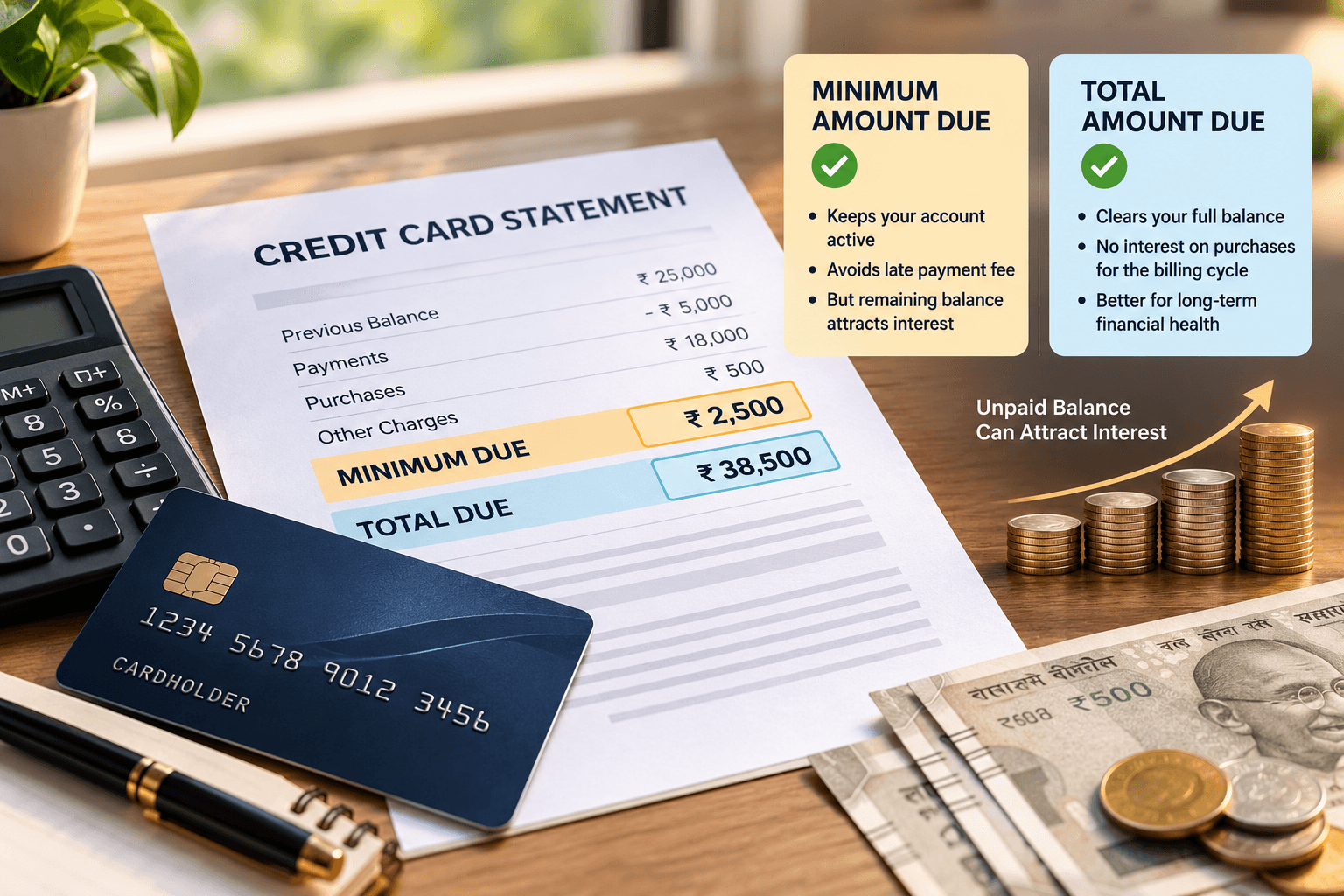
Credit Card Minimum Amount Due vs Total Amount Due in India: What Happens If You Pay Only the Minimum?
By FinanceBlogg Editorial Team
Published: 31 October 2026
Reading time: 8–9 minutes
Category: Loans and Credit
Introduction
Credit cards make everyday payments convenient, whether you are shopping online, paying household bills or booking travel. However, understanding your credit card statement is just as important as knowing how to use your card.
When you receive your monthly credit card bill, you will generally see two important figures: the Minimum Amount Due (MAD) and the Total Amount Due.
Many cardholders assume that paying the minimum amount due is enough to avoid additional costs. While paying the required minimum by the due date can help prevent the account from becoming overdue, it does not mean that your remaining balance is interest-free.
So, what is the difference between minimum amount due and total amount due? What happens when you pay only the minimum? And which payment option is better for your financial health?
Let's understand these terms with practical Indian examples.
1. What Is the Minimum Amount Due on a Credit Card?
The Minimum Amount Due (MAD) is the minimum payment required by your credit card issuer by the payment due date to avoid the bill being treated as overdue, subject to applicable rules.
It is generally a small portion of your outstanding credit card bill. The exact calculation depends on your card issuer's terms and may include applicable interest, fees, taxes and a portion of your outstanding balance.
For example:
Suppose your monthly credit card statement shows:
| Description | Amount |
|---|---|
| Total Amount Due | ₹38,500 |
| Minimum Amount Due | ₹2,500 |
| Payment Due Date | 20 November |
If you pay ₹2,500 by the due date, you have paid the required minimum amount.
However, the remaining ₹36,000 does not disappear. It remains payable, and interest or finance charges may apply according to your card's terms.
Important: Minimum payment is a short-term payment option, not a way to avoid credit card interest.
2. What Is the Total Amount Due on a Credit Card?
The Total Amount Due is the full amount payable against your credit card statement for that billing cycle.
It generally includes:
- Purchases made during the billing cycle.
- Outstanding balances carried forward.
- Applicable interest and fees.
- Other charges reflected in the statement.
- Adjustments and credits, where applicable.
Paying the full amount due by the payment due date is generally the best way to maintain the interest-free benefit on eligible purchases, provided you have no previous unpaid balance and meet your issuer's terms.
For example, if your statement shows a total amount due of ₹38,500, paying ₹38,500 by the due date clears that statement balance.
This can help you avoid purchase-related finance charges that would otherwise apply.
3. Minimum Amount Due vs Total Amount Due: Key Differences
Understanding these two payment options can help you avoid unnecessary borrowing costs.
| Feature | Minimum Amount Due | Total Amount Due |
|---|---|---|
| Payment amount | Minimum required amount | Full statement balance |
| Account overdue status | Can prevent overdue status if paid correctly and on time | Clears the statement balance |
| Interest charges | May apply to unpaid balance | Generally avoided on eligible purchases |
| Interest-free period | Usually suspended when a balance remains unpaid | Can be maintained subject to card terms |
| Remaining balance | Continues to be payable | Statement balance is cleared |
| Long-term cost | Can be higher | Generally lower |
The biggest difference is that paying the minimum amount keeps the remaining debt alive, whereas paying the full statement balance helps prevent it from accumulating interest.
4. What Happens If You Pay Only the Minimum Amount Due?
This is one of the most important things every credit card user should understand.
When you pay only the minimum amount due, several things can happen.
A. Interest May Be Charged on the Remaining Balance
Your unpaid balance can attract finance charges according to the interest rate and calculation method specified by your card issuer.
For certain credit card transactions, interest may be calculated from the transaction date rather than simply from the payment due date when the interest-free period is lost.
B. Your Interest-Free Period May Be Suspended
Credit cards commonly provide an interest-free period on eligible purchases.
However, if you carry an unpaid balance from a previous statement, you may lose this benefit.
New purchases can also attract finance charges according to your issuer's terms.
C. Your Debt Can Become Difficult to Repay
If you repeatedly pay only the minimum amount, a large portion of your money may go towards interest and other applicable charges.
This can make it harder to reduce your outstanding principal balance.
D. Your Available Credit Limit Remains Reduced
The unpaid balance continues to use part of your credit limit.
For example, if you have a ₹1,00,000 credit limit and ₹38,500 remains outstanding, your available limit will generally be reduced by that outstanding amount, subject to adjustments and pending transactions.
5. Practical Example: Paying Minimum Due vs Full Amount
Let's understand the difference with a simple example.
Suppose you have a credit card statement with the following details:
| Particular | Amount |
|---|---|
| Total Amount Due | ₹38,500 |
| Minimum Amount Due | ₹2,500 |
| Credit Limit | ₹1,00,000 |
| Payment Due Date | 20 November |
Now consider two situations.
Scenario 1: You Pay Only ₹2,500
- Payment made: ₹2,500.
- Remaining statement balance: ₹36,000.
- Interest-free benefit: May be suspended.
- Future interest: Depends on your card's applicable finance charges and terms.
You have paid the required minimum, but your credit card debt remains.
Scenario 2: You Pay the Full ₹38,500
- Payment made: ₹38,500.
- Remaining statement balance: ₹0.
- Purchase-related finance charges: Generally avoided on eligible transactions.
- Interest-free benefit: Can continue under the issuer's applicable conditions.
Which is better?
Paying the full statement balance by the due date is generally the better financial decision if you can afford it without compromising essential expenses or emergency savings.
These examples are illustrative. Actual statements can include additional charges, refunds and adjustments.
6. Does Paying the Minimum Amount Due Affect Your CIBIL Score?
Paying only the minimum amount due on time does not automatically mean your CIBIL score will fall.
However, your credit profile can be affected indirectly.
Consider these factors:
Credit utilisation: If a large balance remains outstanding, your credit utilisation ratio may increase. High utilisation can negatively affect how lenders assess your credit profile.
Payment history: Missing required payments or allowing an account to become overdue can affect your credit history.
Outstanding debt: Carrying a large balance for a long period may indicate higher credit risk to lenders.
For example, if your credit card limit is ₹50,000 and your outstanding balance is ₹40,000, your utilisation is 80%.
Although paying the minimum may keep the account from becoming overdue, it does not eliminate the outstanding balance.
You can read our related guide: How Credit Scores Work in India.
7. How to Avoid Credit Card Interest in India
Here are some practical ways to manage your credit card payments more effectively.
1. Pay the Full Statement Balance
Try to pay the total amount due before the payment due date rather than relying on minimum payments.
2. Set Payment Reminders
Use your banking app or calendar to receive reminders a few days before the due date.
3. Avoid Spending Beyond Your Budget
A credit limit is not the same as your actual spending capacity. Use your card according to your monthly income and repayment ability.
4. Check Your Monthly Statement
Review all purchases, fees, interest charges and payment adjustments. Report any unfamiliar transactions to your card issuer promptly.
5. Avoid Cash Withdrawals Using Credit Cards
Credit card cash advances can attract separate fees and interest from the transaction date. Check the applicable terms before withdrawing cash.
6. Contact Your Bank if You Cannot Pay the Full Bill
If you are facing repayment difficulties, contact your card issuer early and ask about available options. Understand the interest, fees and repayment implications before accepting any arrangement.
8. What Does the RBI Say About Minimum Credit Card Payments?
The Reserve Bank of India (RBI) has issued directions to protect credit card customers and improve transparency.
Important provisions include:
- Card issuers must inform customers about the consequences of paying only the minimum amount due.
- Billing statements must prominently warn that minimum-only payments can extend repayment over months or years with additional interest.
- The interest-free credit period is suspended if a previous month's balance remains outstanding.
- Interest is levied on the outstanding amount, adjusted for payments, refunds and reversed transactions.
- Late payment charges are subject to RBI requirements and the applicable card terms.
The RBI also requires card issuers to explain the interest calculation methodology and provide relevant disclosures.
Read the official RBI credit card directions before relying on any general explanation.
Official reference: https://www.rbi.org.in/ (opens in a new tab)
9. Frequently Asked Questions (FAQs)
Is it good to pay only the minimum amount due on a credit card?
Paying the minimum amount can help prevent the bill from becoming overdue if paid correctly and on time. However, the remaining balance may attract interest. It is generally better to pay the full statement balance.
What happens if I pay only the minimum amount due every month?
Your remaining balance can continue to attract interest and take much longer to repay. Repeated minimum payments can increase your total borrowing cost.
Will my CIBIL score decrease if I pay only the minimum due?
Not automatically. Paying the minimum on time is different from missing a payment. However, high outstanding balances and credit utilisation can affect your credit profile.
Can I use my credit card after paying the minimum amount due?
Generally, yes, subject to your available credit limit and issuer's terms. However, new purchases may not receive the normal interest-free period while an earlier balance remains unpaid.
Is the minimum amount due the same for every bank?
No. The calculation depends on the card issuer's policies and applicable regulations. Check your monthly statement and Most Important Terms and Conditions (MITC).
What if I cannot pay even the minimum amount due?
Contact your card issuer as soon as possible. Ask about available repayment options and understand applicable interest, late fees and credit reporting consequences. Avoid taking another expensive loan without carefully considering the total cost.
Final Thoughts
Understanding the difference between minimum amount due and total amount due is essential for responsible credit card usage.
The minimum payment option can help you avoid an overdue account when you are temporarily unable to pay the full bill. However, it should not become your regular repayment strategy.
Whenever possible, pay your full credit card statement balance before the due date, monitor your spending and review your monthly statements.
Remember: A credit card is a payment facility, not additional income. Using it responsibly can help you manage your finances, while carrying unpaid balances can make borrowing expensive.
Editorial Disclaimer: This article is for general educational purposes for readers in India. Credit card charges, interest rates and repayment conditions vary by issuer and may change. Always check your latest card statement, MITC and official RBI directions before making financial decisions.
Related reading on FinanceBlogg:
- How Credit Scores Work in India
- Understanding Loan Interest Rates
- Before You Take a Loan in India: 9 Checks to Avoid Costly Borrowing Mistakes
Official source: Reserve Bank of India – https://www.rbi.org.in/ (opens in a new tab)
About the author
FinanceBlogg Editorial Team
Editorial Team
The FinanceBlogg editorial team researches and writes educational explainers on personal finance in India. Articles are based on official sources such as the Reserve Bank of India, SEBI, IRDAI and the Income Tax Department, and are updated when rules change.
View profile and articlesSpotted an error? Read our corrections policy and tell us.
Related articles
Before You Take a Loan in India: 9 Checks to Avoid Costly Borrowing Mistakes
Learn 9 important things to check before taking a loan in India, from total borrowing costs and EMIs to fees, penalties and repayment risks
· 8 min read
How Loan Prepayment and Foreclosure Work
What loan prepayment and foreclosure mean in India, how extra payments change interest, typical charges, and what to check in your sanction letter.
· 6 min read

How a Loan EMI Is Calculated
How a loan EMI is calculated in India, why early EMIs are mostly interest, and how tenure and rate change what you repay.
· 4 min read