Emergency Funds: How Much Should You Save?
How to size an emergency fund for your situation, where to keep it so it is safe and accessible, and how to build one gradually.
By Rupee Ledger Editorial Team
Published 6 min read
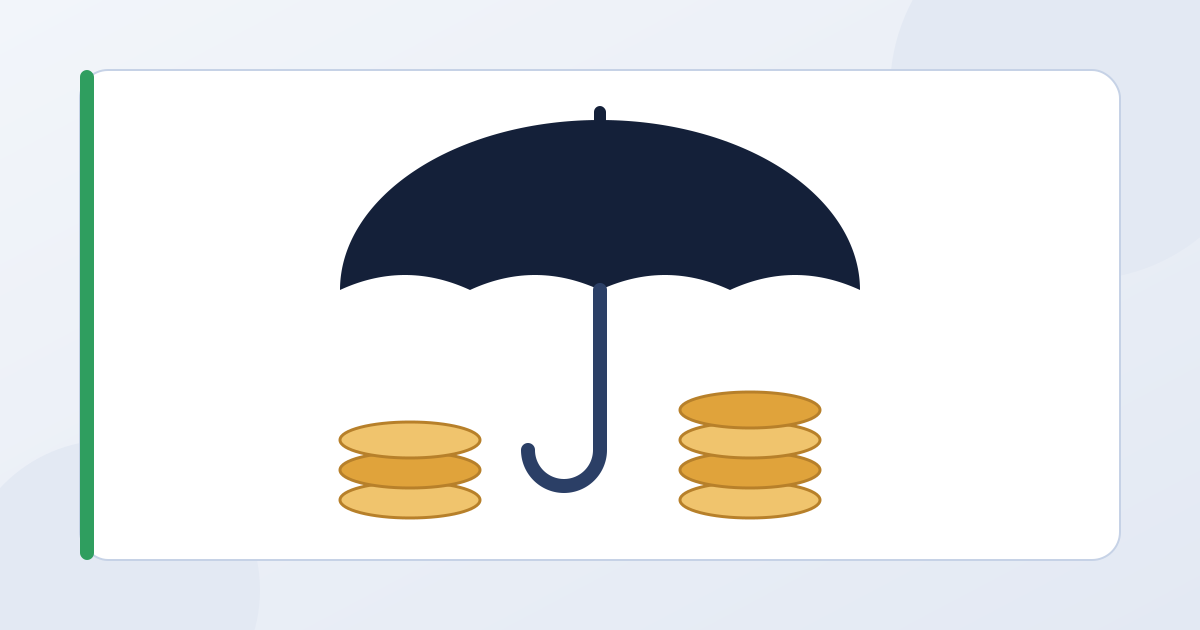
An emergency fund is money set aside for one purpose: covering an unexpected expense or a loss of income without borrowing, selling investments at a bad time, or falling behind on bills. It is the foundation that makes every other financial goal more secure.
The hard questions are practical ones. How much is enough? Where should it sit? And how do you build it when money is already tight?
What counts as an emergency
An emergency is something unexpected and necessary. Examples include:
- losing your job or a sudden drop in business income;
- a medical expense not fully covered by insurance;
- an urgent home or vehicle repair you depend on;
- unplanned travel for a family emergency.
Expected expenses, such as festivals, school fees, insurance premiums and a planned holiday, are not emergencies. They belong in a separate "sinking fund" that you save for in advance, as explained in our guide to creating a monthly budget. Keeping the two separate stops predictable costs from quietly emptying your emergency fund.
How much should you save?
Step 1: Work out your essential monthly expenses
List only what you would have to pay if your income stopped:
- rent or home loan EMI;
- other loan EMIs and minimum credit card payments;
- groceries and household essentials;
- utilities, mobile and internet;
- insurance premiums, converted to a monthly figure;
- school fees, converted to a monthly figure;
- essential transport and medicines;
- regular support to dependants.
Leave out discretionary spending such as eating out and shopping, which you could cut in an emergency.
Step 2: Choose how many months to cover
Financial educators commonly suggest three to six months of essential expenses. Treat that as a starting range rather than a rule, and adjust for your circumstances:
| Your situation | Consider holding |
|---|---|
| Two stable incomes, no dependants, good health cover | Towards the lower end |
| Single income supporting a family | Towards the upper end or more |
| Freelance, commission, seasonal or business income | Six months or more |
| Older dependants or ongoing health conditions | More, to cover costs insurance may not |
| Job in a sector with frequent layoffs or long hiring cycles | More |
Health insurance changes the maths
Medical bills are one of the most common emergencies in India. Adequate health insurance reduces how much you need to hold for them, but does not remove the need entirely. Policies can have co-payments, room rent limits, waiting periods and exclusions, and there are costs like travel that insurance does not pay. See our guide on how to compare health insurance policies.
Where to keep your emergency fund
The goal is safety and access first, and returns a distant third. A sensible approach is to split the fund into layers.
Layer 1: Immediate access (savings account)
Keep enough for the first few weeks of an emergency in a savings account, ideally one separate from your everyday spending account so that you are not tempted to dip into it. Money is available instantly through UPI, net banking or an ATM.
Layer 2: Within a few days (fixed deposits or sweep-in deposits)
Fixed deposits usually pay more than savings accounts, and most can be broken early, though with lower interest and a penalty. Splitting this layer into several smaller FDs means you only need to break one. Some banks offer sweep-in accounts that move surplus balances into FDs automatically and break them when needed.
Bank deposits, including savings accounts and FDs, are insured by DICGC up to ₹5 lakh per depositor per bank, combined across all deposits at that bank.
Layer 3: Optional, for larger funds (liquid or overnight funds)
Some people keep part of a larger emergency fund in liquid funds or overnight funds, which are debt mutual funds that invest in very short-term instruments. Redemptions are usually credited by the next business day, and some fund houses offer instant redemption for a limited amount.
These funds are low-risk but not risk-free and not insured by DICGC. Their value can fall slightly in rare situations, and gains are taxable. Use them only if you understand how they work.
What to avoid
- Equity shares and equity mutual funds. Their value can fall sharply just when you need the money.
- Products with lock-ins, such as PPF, tax-saving FDs, ELSS funds, or long-term deposits that cannot be broken.
- Gold jewellery or property, which can be slow or costly to sell and emotionally hard to part with.
- Your credit card limit. It is borrowing at high interest, not savings.
- Money lent to friends or family, however reliable they are.
How to build it gradually
A full emergency fund can feel out of reach. Break it down:
- Set a first milestone of one month of essential expenses, then work towards three, then six.
- Automate a monthly transfer on salary day into a separate account or recurring deposit.
- Direct windfalls such as a bonus, tax refund or cash gifts partly into the fund.
- Cut one or two discretionary expenses temporarily and redirect that amount.
If you also have high-interest debt, such as an unpaid credit card balance, many people find it useful to build a small starter fund first and then focus on clearing the expensive debt, because card interest usually far exceeds what savings earn.
Using and refilling the fund
When a genuine emergency happens, use the fund without guilt. That is what it is for. Use layer 1 first, then layer 2. Afterwards, restart your monthly transfers until the fund is back to its target.
Review the target once a year, or whenever your expenses change significantly, such as after moving house, having a child or taking a new loan.
Finally, make sure a trusted family member knows the fund exists and how to access it, and that nominations on the accounts are up to date.
Sources and further reading
We link to official and primary sources wherever possible. Rules and rates change, so check the latest version on the source website.
- Deposit Insurance and Credit Guarantee Corporation (DICGC) — DICGC
- Investor education on mutual funds — Association of Mutual Funds in India (AMFI)See the investor section for explanations of liquid and overnight fund categories and how redemptions work.
- SEBI Investor Website — Securities and Exchange Board of India
- National Centre for Financial Education — NCFE
About the author
Rupee Ledger Editorial Team
Editorial Team
The Rupee Ledger editorial team researches and writes educational explainers on personal finance in India. Articles are based on official sources such as the Reserve Bank of India, SEBI, IRDAI and the Income Tax Department, and are updated when rules change.
View profile and articlesSpotted an error? Read our corrections policy and tell us.
Related articles
How to Create a Monthly Budget in India
A practical, step-by-step guide to building a monthly budget in India, with a worked example, sinking funds for annual expenses and the limits of popular budgeting rules.
· 7 min read
How Inflation Affects Your Savings
How inflation is measured in India, the difference between nominal and real returns, the effect of tax, and how time horizon shapes your savings.
· 5 min read