How Inflation Affects Your Savings
What inflation is, how it is measured in India, why real returns matter more than headline interest rates, and how time horizon shapes where money should sit.
By Rupee Ledger Editorial Team
Published 5 min read
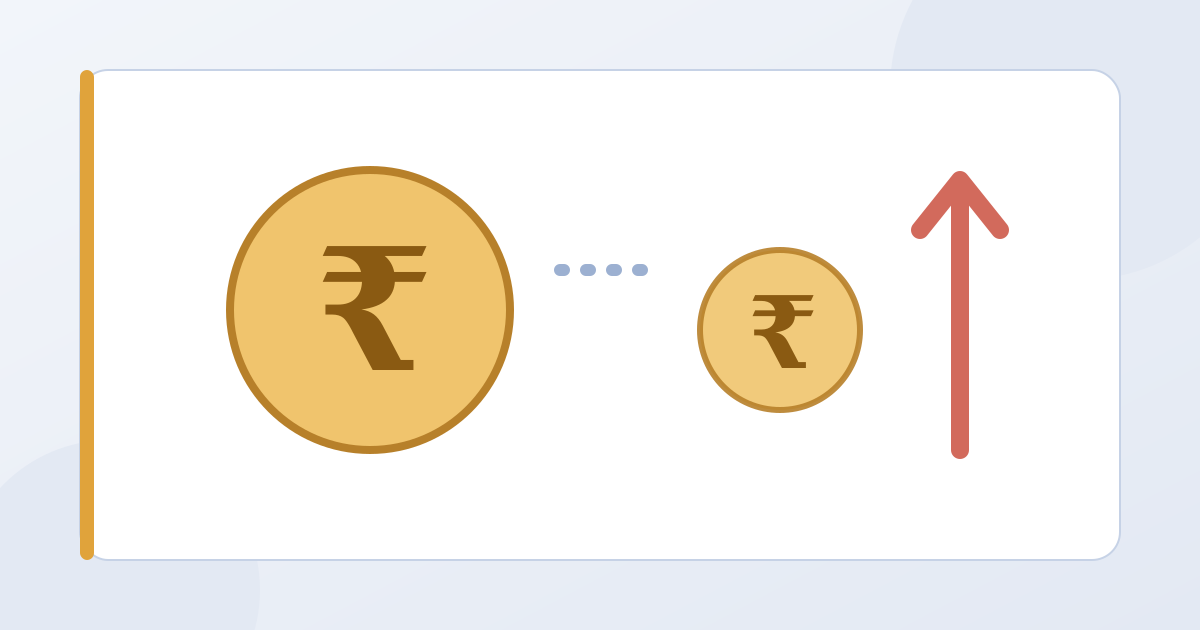
If a packet of groceries costs ₹1,000 today and ₹1,060 a year from now, your money has lost some of its purchasing power, even though the number in your bank account has not changed. That is inflation. It works slowly and quietly, which is exactly why it is easy to ignore and important to understand.
What inflation is and how India measures it
Inflation is the rate at which the general level of prices rises. In India, the most widely followed measure is CPI inflation, published monthly by the National Statistics Office under the Ministry of Statistics and Programme Implementation. The CPI tracks the prices of a basket of goods and services that households typically buy, including food, housing, clothing, fuel, health, education and transport.
The Reserve Bank of India uses CPI inflation as the main target for monetary policy. Under India's flexible inflation-targeting framework, the target is 4% CPI inflation, with a tolerance band of 2% to 6%. The RBI's Monetary Policy Committee adjusts the policy repo rate partly to keep inflation within this range.
Nominal vs real return
The nominal return is the headline rate: the interest an FD pays, or the percentage gain on an investment. The real return is what is left after inflation, and it tells you whether your money is actually buying more over time.
A quick approximation is:
Real return ≈ nominal return − inflation
The precise formula is (1 + nominal) ÷ (1 + inflation) − 1, but the approximation is close enough for most everyday comparisons.
Don't forget tax
Interest from deposits is taxed at your slab rate, which lowers the return further.
This is not an argument against deposits. For money you need in the near future, safety and access are worth more than a higher return. It does mean that long-term goals funded only from deposits may need much larger savings than people expect.
How inflation compounds over time
The effect of inflation grows with time, just like interest.
A handy shortcut is the rule of 72: divide 72 by the inflation rate to estimate how many years it takes for prices to double, or for the purchasing power of cash to halve. At 6% inflation, that is about 72 ÷ 6 = 12 years.
Your personal inflation rate
The official CPI is an average across many households. Your own inflation rate depends on what you spend on. For example:
- families paying school or college fees may see education costs rise faster than the average;
- older households may spend a larger share on healthcare;
- a household that rents in a city where rents are rising will feel that more than one that owns its home.
When planning for a specific goal, such as a child's education, use an estimate that reflects that cost rather than the headline CPI. Treat any such estimate as an assumption to revisit, not a certainty.
Matching savings to time horizons
A practical way to think about inflation is to sort your money by when you will need it:
| Time horizon | Main priority | Inflation's role |
|---|---|---|
| Under about 3 years, including emergency funds | Safety and access | Accept a low real return; protecting the money matters more |
| About 3 to 7 years | Balance of stability and growth | Consider options that may beat inflation, while limiting the risk of a large fall near the goal |
| Over about 7 years | Growth that outpaces inflation | Inflation does the most damage here, so the plan has to account for it |
These ranges are rough guides, not rules. Investments with the potential to beat inflation over long periods, such as equity, also come with the risk of significant falls in value along the way, and no investment guarantees a positive real return. Our explainer on SIPs and mutual fund investing covers how such risks work.
Practical steps
- Separate short-term and long-term money. Keep your emergency fund and near-term savings safe. Plan long-term goals separately.
- Estimate goals in future rupees. If a goal costs ₹10 lakh today and is ten years away, its future cost could be considerably higher.
- Compare returns after tax and inflation, not just headline rates.
- Review your plan each year, as inflation, rates and your circumstances change.
- Diversify rather than relying on a single type of asset.
Sources and further reading
We link to official and primary sources wherever possible. Rules and rates change, so check the latest version on the source website.
- Monetary Policy — Reserve Bank of IndiaMonetary Policy Committee statements and the inflation-targeting framework.
- Consumer Price Index releases — Ministry of Statistics and Programme Implementation (MoSPI)Official monthly CPI data published by the National Statistics Office.
- Financial Education — Reserve Bank of India
- SEBI Investor Website — Securities and Exchange Board of India
About the author
Rupee Ledger Editorial Team
Editorial Team
The Rupee Ledger editorial team researches and writes educational explainers on personal finance in India. Articles are based on official sources such as the Reserve Bank of India, SEBI, IRDAI and the Income Tax Department, and are updated when rules change.
View profile and articlesSpotted an error? Read our corrections policy and tell us.
Related articles
Understanding SIP and Mutual Fund Investing
A beginner's guide to mutual funds and SIPs in India: NAV, fund categories, direct vs regular plans, costs, risks, rupee cost averaging and tax.
· 8 min read

How to Create a Monthly Budget in India
A practical, step-by-step guide to building a monthly budget in India, with a worked example, sinking funds for annual expenses and the limits of popular budgeting rules.
· 7 min read

Emergency Funds: How Much Should You Save?
How to size an emergency fund for your household in India, why three to six months is only a starting point, and where to keep the money safely.
· 6 min read