How Credit Scores Work in India
What a credit score measures, who calculates it, what affects it, and how to check and correct your credit report.
By Rupee Ledger Editorial Team
Published 7 min read
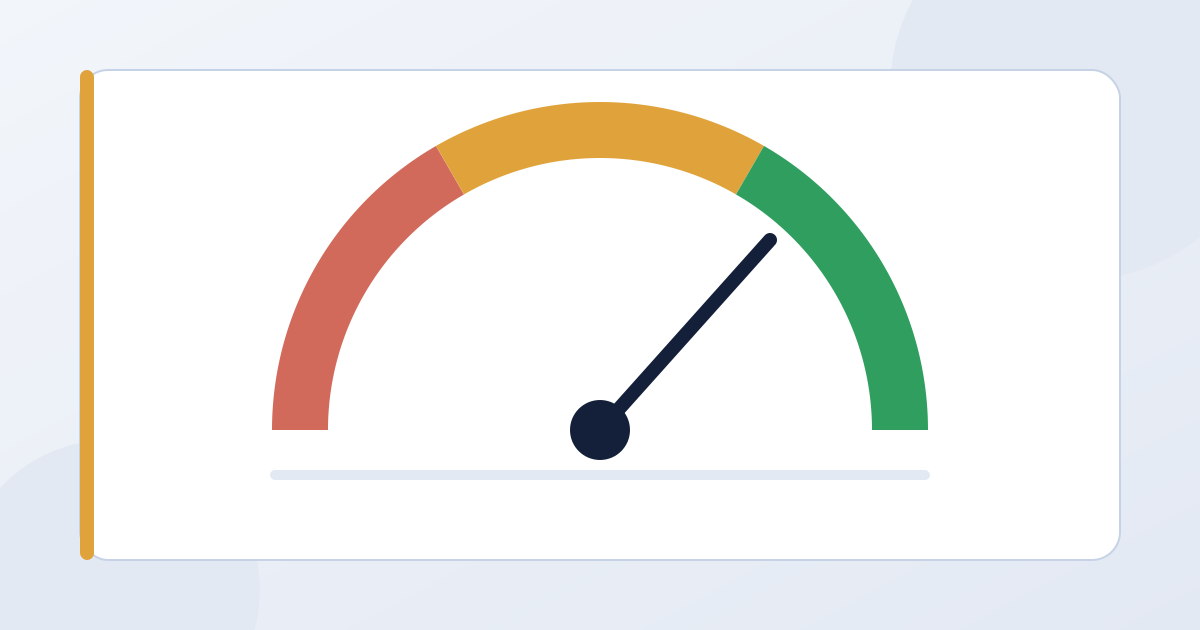
When you apply for a loan or a credit card, the lender almost always checks your credit report and credit score. A good score can make approval easier and may help you get better terms. A weak score, or no credit history at all, can mean a rejection or a higher interest rate.
Despite this, credit scores are widely misunderstood. This guide explains what a score actually measures, what helps and hurts it, and what you can do if your report contains a mistake.
Credit report vs credit score
A credit report is a detailed record of your borrowing. It typically includes:
- your personal details, such as name, date of birth, PAN and addresses;
- every loan and credit card in your name, with the lender, the amount, the current balance and the account status;
- your monthly repayment history, including any days past due (DPD), which shows how late a payment was;
- enquiries, which are records of lenders checking your report after you applied for credit.
A credit score is a three-digit number calculated from your report using a statistical model. It summarises how likely you are, based on your history, to repay on time. The scores commonly used in India fall within a range of about 300 to 900, with higher numbers indicating lower risk.
Who calculates credit scores in India
Credit scores are produced by credit information companies (CICs), often called credit bureaus. They are licensed by the Reserve Bank of India under the Credit Information Companies (Regulation) Act, 2005. There are four:
- TransUnion CIBIL
- Experian
- Equifax
- CRIF High Mark
Banks and other regulated lenders report information about their borrowers to these bureaus. Because each bureau uses its own model, and because lenders may report to them at slightly different times, your score can differ from one bureau to another. That is normal.
People often say "CIBIL score" to mean any credit score, but CIBIL is just one of the four bureaus.
What affects your score
Bureaus do not publish their exact formulas, but the main factors are well established:
| Factor | What it means | What helps |
|---|---|---|
| Repayment history | Whether you paid EMIs and card bills on time | Paying every due amount on or before the due date |
| Credit utilisation | How much of your credit card limit you are using | Keeping balances well below your limit |
| Length of credit history | How long you have had credit accounts | Keeping older accounts in good standing |
| Credit mix | The types of credit you hold, such as cards and secured loans | A sensible mix built over time, not loans taken only for the score |
| Recent enquiries | How many times you have applied for new credit recently | Avoiding many applications in a short period |
Repayment history is generally the most important. A single payment that is 30 or more days late can stay on your report for a long time. Even a small missed payment on a credit card counts.
Utilisation is easy to misjudge. If your card limit is ₹1,00,000 and your statement balance is ₹60,000, you are using 60% of your limit, even if you pay the bill in full. A commonly cited rule of thumb is to keep utilisation below about 30%, but this is guidance, not an official threshold.
What does not affect your score
Several things people worry about are not part of a credit score:
- Checking your own score or report. This is a "soft" enquiry and does not lower your score. A "hard" enquiry happens when a lender checks your report because you applied for credit.
- Your income or salary. Lenders look at income separately, but it is not in your credit report.
- Your savings or investments. A large FD does not raise your score, although it may help you get a secured credit card if you have no history.
- Debit card and UPI usage. These are payments from your own money, not credit.
No credit history is not the same as bad credit
If you have never had a loan or credit card, the bureaus may have nothing to score. Your report may show that no score is available. This is not a negative mark, but some lenders may be cautious about lending to someone without a track record.
Common ways people build a history include a secured credit card, issued against a fixed deposit, or a small loan that is repaid on schedule. Use any such product only if you would otherwise use it responsibly.
Common situations that hurt scores
- Paying only the minimum due on a credit card. This avoids a late-payment mark, but the remaining balance attracts high interest and keeps utilisation high.
- "Settling" a loan. If you negotiate to pay less than the full amount owed, the account may be reported as "settled" rather than "closed". Lenders generally view a settled account negatively.
- Being a co-borrower or guarantor. If you guarantee someone else's loan and they miss payments, it can affect your report too.
- Many applications at once. Applying to several lenders in a short time creates multiple hard enquiries.
- Errors. A loan you never took, a closed loan still shown as open, or a payment incorrectly marked late can all lower your score.
How to check your credit report for free
RBI rules require each credit bureau to give individuals one free full credit report, including the score, every calendar year. Because there are four bureaus, you can check your report up to four times a year at no cost by requesting from each bureau in turn. You can request it from the bureau's official website.
When you check, look for:
- accounts you do not recognise, which may indicate identity misuse;
- closed loans still shown as active;
- incorrect overdue amounts or late payments;
- errors in your name, date of birth, PAN or address.
Be cautious of third-party websites that ask for unnecessary personal details or charge fees for "credit repair".
How to dispute an error
- Raise a dispute with the bureau through its website, explaining the error and attaching proof if you have it, such as a loan closure letter or a no-dues certificate.
- The bureau checks with the lender that reported the data. If the lender confirms the error, the record is corrected.
- You can also contact the lender directly, since it is responsible for the data it reports.
- If your complaint is not resolved satisfactorily, you can escalate to the RBI Ombudsman through the RBI Complaint Management System (opens in a new tab).
RBI rules set timelines for credit bureaus and lenders to resolve complaints, and provide for compensation if they take too long.
Can anyone "fix" a bad score quickly?
No one can legally remove accurate negative information from your report. Companies promising to delete late payments or boost your score quickly for a fee should be treated with caution. Genuine improvement comes from:
- paying every bill and EMI on time from now on;
- bringing down credit card balances;
- avoiding unnecessary new applications;
- correcting genuine errors through the dispute process.
Scores usually improve gradually as recent good behaviour builds up and older problems become less significant.
Sources and further reading
We link to official and primary sources wherever possible. Rules and rates change, so check the latest version on the source website.
- Credit Information Companies — Reserve Bank of IndiaSearch "credit information companies" for the list of licensed CICs and related circulars and FAQs.
- TransUnion CIBIL — TransUnion CIBIL Limited
- Experian India — Experian Credit Information Company of India
- Equifax India — Equifax Credit Information Services
- CRIF High Mark — CRIF High Mark Credit Information Services
- RBI Complaint Management System — Reserve Bank of India
About the author
Rupee Ledger Editorial Team
Editorial Team
The Rupee Ledger editorial team researches and writes educational explainers on personal finance in India. Articles are based on official sources such as the Reserve Bank of India, SEBI, IRDAI and the Income Tax Department, and are updated when rules change.
View profile and articlesSpotted an error? Read our corrections policy and tell us.
Related articles

Understanding Loan Interest Rates
How loan interest works in India: fixed vs floating, repo-linked rates, flat vs reducing balance, EMI maths, APR and the Key Fact Statement.
· 7 min read
Common Personal Finance Mistakes and How to Avoid Them
Twelve common money mistakes in India, from skipping an emergency fund to paying only the credit card minimum, and practical ways to avoid each one.
· 6 min read