What Are Index Mutual Funds? How They Work in India
By FinanceBlogg Editorial Team
Published 4 min read
Editorially reviewed by FinanceBlogg Editorial Team on . How we review articles
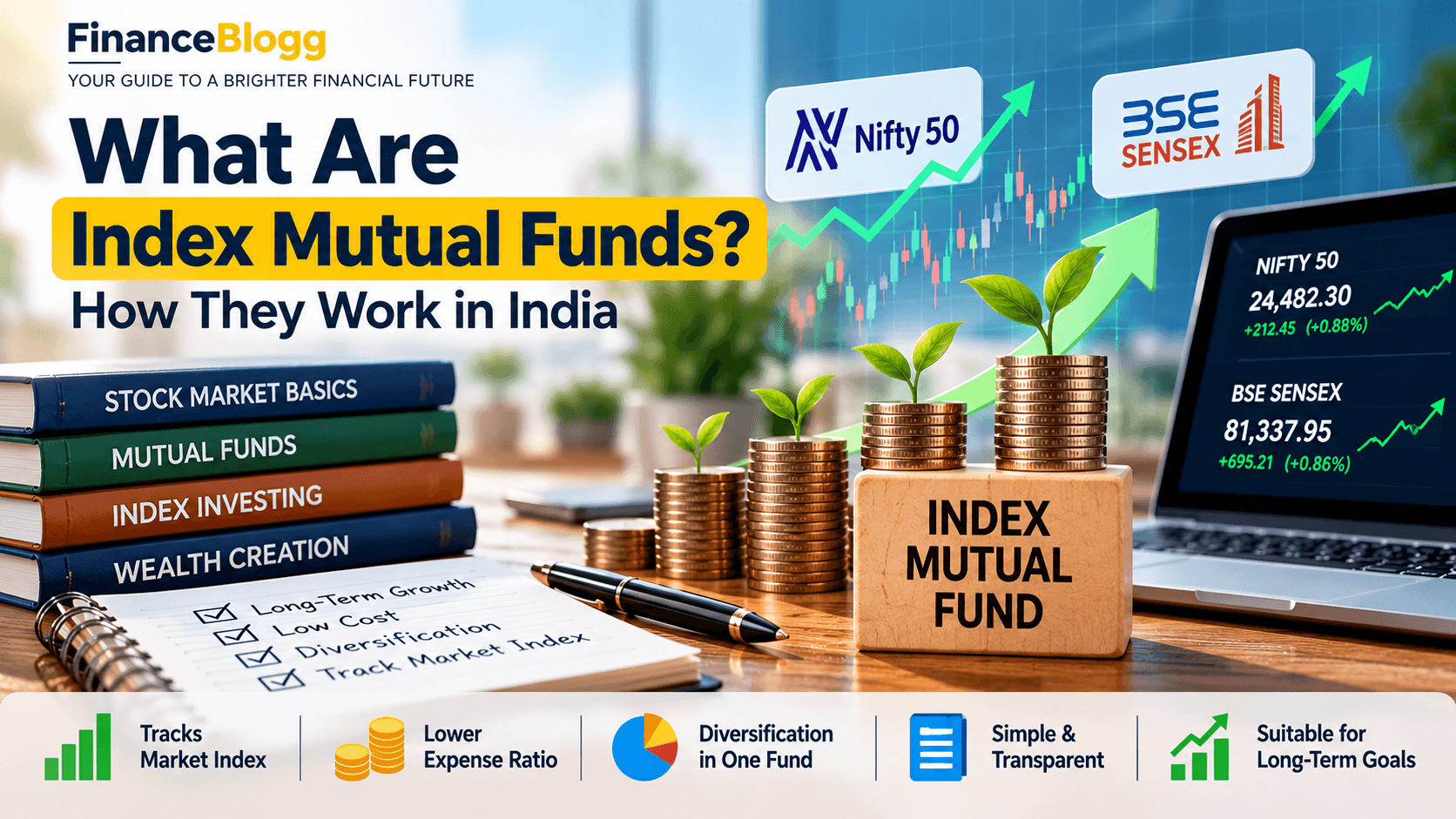
What Are Index Mutual Funds? How They Work in India Index mutual funds are investment funds designed to track a particular market index. Rather than trying to select stocks to outperform the market, these funds generally aim to replicate the performance of their chosen benchmark, subject to expenses and tracking differences.
In India, investors may encounter funds tracking indices such as the Nifty 50 or the BSE Sensex. Understanding how these products work can help beginners evaluate them more carefully. What Is a Market Index? A market index measures the performance of a selected group of securities according to defined rules.
For example, the Nifty 50 represents a group of 50 major companies listed on the National Stock Exchange of India. An index's composition and weighting methodology determine how individual constituents affect its performance.
An index is a benchmark, not a promise of investment returns. How Do Index Mutual Funds Work? An index mutual fund typically holds securities in proportions intended to follow its benchmark. The fund may use full replication or another permitted method, depending on its investment strategy.
If the benchmark's constituents or weights change, the fund may also adjust its portfolio.
The fund's return can differ from the index because of expenses, cash holdings, trading costs, taxes within the portfolio and other operational factors. Potential Benefits of Index Funds A straightforward investment approach: The objective is generally to follow an index rather than select individual winners.
Diversification within the benchmark: One fund can provide exposure to multiple securities, although diversification depends on the index itself.
Cost transparency: Index funds often have relatively low management expenses compared with some actively managed alternatives, but costs vary between funds.
A clear benchmark: Investors can compare the fund's performance with the index it is designed to track.
These characteristics can be useful, but they do not make index funds suitable for every investor. What Risks Should You Understand? Market risk If the underlying index declines, an index fund tracking it will generally also decline. Diversification within an index does not prevent broad market losses. Concentration risk Some indices have significant exposure to particular sectors or large companies. Owning an index fund does not automatically mean that risk is evenly spread. Tracking difference The fund's actual return may differ from the benchmark's return. Compare tracking difference over appropriate periods and understand that historical results can change. Costs and taxes Check the expense ratio, any applicable exit load and the tax treatment relevant to your investment and redemption date. Rules can change, so verify current requirements before acting.
index Mutual Funds vs Actively Managed Funds
Feature -Main objective -Portfolio decisions -Costs -Market risk -Outperformance
Index fund -Track a benchmark -Generally benchmark-driven -Often lower, but vary -Present -Not the primary objective
Active fund -Follow an active investment strategy -Manager-driven -Often higher, but vary -Present -Possible, not guaranteed
Neither approach guarantees superior performance. Compare funds using their objectives, risks, costs and consistency rather than one recent return figure. What Should Investors Check Before Investing? Review the scheme information document and factsheet. Check the benchmark, portfolio concentration, expense ratio, tracking difference, riskometer, exit load and redemption terms.
Also consider whether the investment fits your time horizon and capacity to withstand losses. Equity index funds may be unsuitable for money needed in the near term.
Direct and regular plans, where offered, can have different expenses. Understand the plan you are considering and whether you need distribution or advisory services. Frequently Asked Questions Are index mutual funds safe? They are subject to the risks of their underlying securities. An equity index fund can lose value, including over extended periods. Do index funds guarantee market returns? No. They aim to track a specified benchmark, and their actual returns can differ because of costs and tracking factors. Are index funds and ETFs the same? No. Index mutual funds and exchange-traded funds can both track an index, but they differ in how investors transact. ETFs trade on stock exchanges during market hours, while mutual fund transactions generally follow applicable NAV and cut-off rules. Final Thoughts Index mutual funds offer a relatively straightforward way to access a defined market benchmark. Before choosing one, understand the index, the fund's costs, its tracking behaviour and the possibility of losses. Read the official scheme documents rather than relying only on promotional material.
Disclaimer: This article is educational and is not a recommendation to buy or sell any mutual fund.
About the author
FinanceBlogg Editorial Team
Editorial Team
The FinanceBlogg editorial team researches and writes educational explainers on personal finance in India. Articles are based on official sources such as the Reserve Bank of India, SEBI, IRDAI and the Income Tax Department, and are updated when rules change.
View profile and articlesSpotted an error? Read our corrections policy and tell us.
Related articles

How to Read a Mutual Fund Factsheet
How to read a mutual fund factsheet in India: NAV, TER, portfolio, riskometer, exit load and what the numbers do not tell you.
· 4 min read

Direct vs Regular Mutual Fund Plans: What Changes, and What Does Not
How direct and regular mutual fund plans differ, why expense ratios compound, how to check which plan you hold, and what a regular plan’s commission pays for.
· 6 min read

Understanding SIP and Mutual Fund Investing
A beginner's guide to mutual funds and SIPs in India: NAV, fund categories, direct vs regular plans, costs, risks, rupee cost averaging and tax.
· 8 min read