GST Invoice in India: Meaning, Key Details and Common Mistakes
By FinanceBlogg Editorial Team
Published 4 min read
Editorially reviewed by FinanceBlogg Editorial Team on . How we review articles
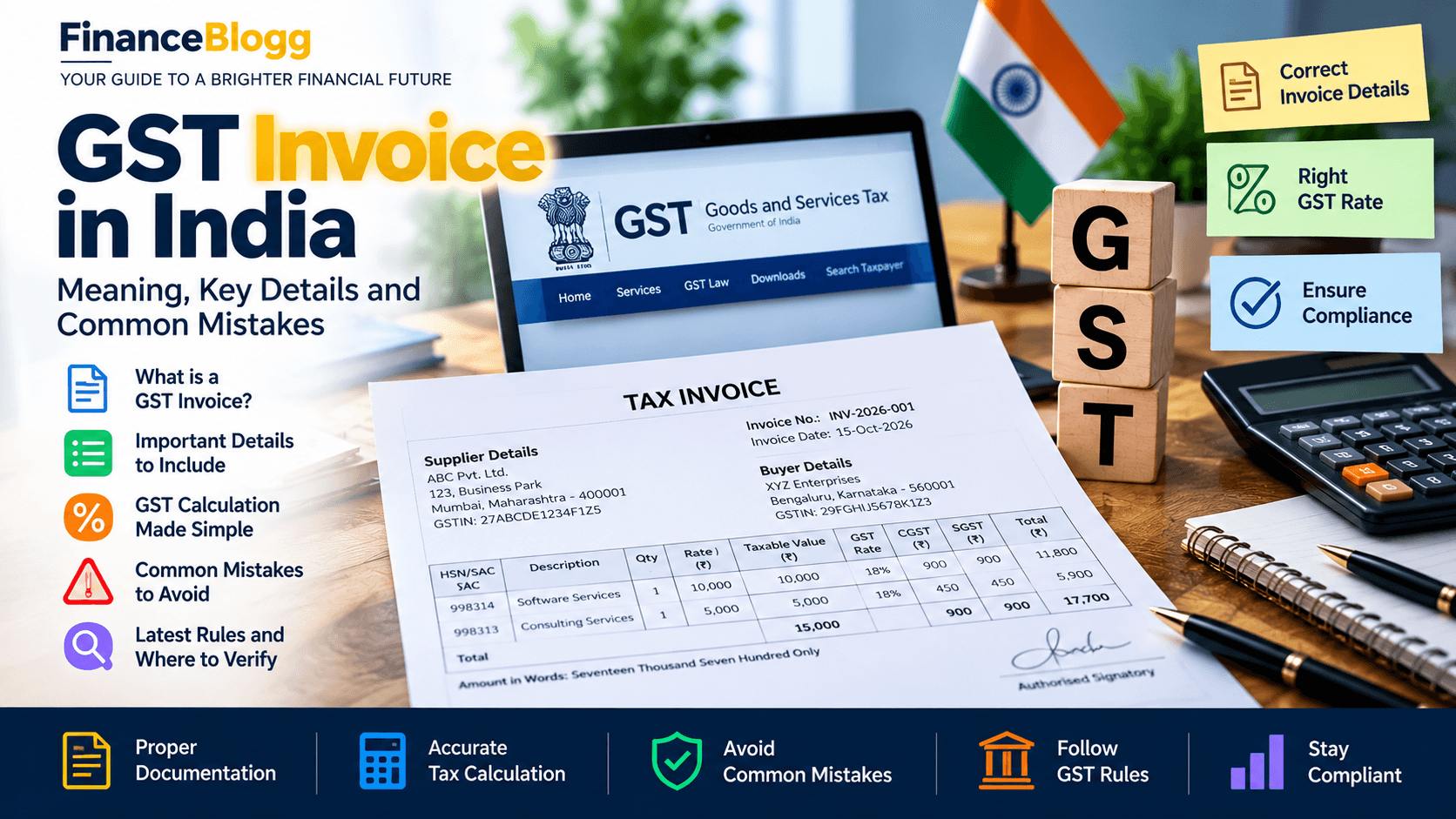
GST Invoice in India: Meaning, Key Details and Common Mistakes A GST invoice is an important document used for recording taxable supplies of goods or services under India's Goods and Services Tax system. It helps businesses document transactions, show applicable tax details and maintain accounting records.
Understanding GST invoices can help business owners, freelancers and customers read billing documents more accurately. However, the exact invoicing requirements depend on the nature of the supply, the supplier's registration status and applicable GST rules. What Is a GST Invoice? A GST tax invoice is generally issued by a registered supplier when required under GST law for a taxable supply.
It records information about the supplier, recipient where applicable, goods or services, taxable value and relevant tax details.
Not every business transaction requires the same document. Depending on the circumstances, a bill of supply, receipt voucher or another prescribed document may be relevant instead. Important Details on a GST Invoice Depending on the applicable rules, a tax invoice may need to include:
- Supplier's legal name, address and GSTIN.
- A unique invoice number and date.
- Recipient details and GSTIN, where required.
- Description of goods or services.
- HSN or SAC classification where applicable.
- Quantity and unit details for goods, where relevant.
- Taxable value after applicable adjustments.
- Applicable CGST, SGST, UTGST or IGST amounts and rates.
- Place of supply and other prescribed information, where required. The exact requirements can vary. Businesses should refer to the current CGST Rules and other applicable notifications rather than treating a generic checklist as universally sufficient. Understanding CGST, SGST and IGST GST invoices may show different tax components depending on the nature and location of the supply.
In a typical intra-state taxable supply, CGST and SGST are generally applied together. For a typical inter-state taxable supply, IGST generally applies.
The legal place of supply and applicable exceptions matter, so the customer's address alone may not always determine the tax treatment. Illustrative GST calculation Suppose a taxable service has a value of ₹10,000 and an illustrative GST rate of 18%.
- Taxable value: ₹10,000
- GST at 18%: ₹1,800
- Total invoice value: ₹11,800 This example explains the arithmetic only. The correct rate depends on the actual goods or services and applicable law. Do not assume that 18% applies to every transaction. Tax Invoice vs Bill of Supply A tax invoice is generally used by a registered supplier for taxable supplies where an invoice is required under GST law.
A bill of supply may be relevant for specified supplies, including supplies by eligible composition taxpayers or exempt supplies, subject to the applicable rules.
These documents serve different purposes. Businesses should establish which document is required before issuing a bill. Common GST Invoice Mistakes
- Using the wrong GST rate GST rates depend on classification and applicable notifications. Verify the correct rate using official GST resources.
- Entering incorrect customer or GSTIN details Incorrect information may create accounting and compliance issues. Check the details before issuing the invoice.
- Applying CGST and SGST or IGST incorrectly The treatment depends on the legally applicable supply classification and place-of-supply rules.
- Reusing invoice numbers incorrectly Follow the applicable invoice numbering and recordkeeping requirements. Maintain a clear audit trail for corrections and cancellations.
- Ignoring e-invoicing requirements E-invoicing obligations apply to specified taxpayers and transactions under the prevailing rules and notifications. Eligibility and exemptions should be checked against current official guidance. Where Can You Verify GST Requirements? For current compliance information, consult the official GST portal at gst.gov.in and the relevant government notifications and rules.
Businesses with complex transactions, exports, interstate supplies or uncertainty about registration and invoicing should seek advice from a qualified tax professional. Frequently Asked Questions Can an unregistered person issue a GST tax invoice? A person who is not registered under GST generally cannot issue a GST tax invoice as a registered supplier or collect GST as if authorised to do so. The appropriate document depends on the transaction and applicable law. Is GST calculated on the taxable value or total invoice value? GST is generally calculated on the applicable taxable value, subject to statutory valuation rules and adjustments. The correct calculation depends on the transaction. Is a GST invoice enough to claim input tax credit? An invoice alone does not automatically establish eligibility for input tax credit. Other legal conditions, documentation and reporting requirements may apply. Final Thoughts A correctly prepared GST invoice supports accurate billing, accounting and tax compliance. Verify supplier and recipient details, classification, tax treatment and applicable invoicing rules before issuing documents. As GST requirements can change, use official sources for current compliance decisions.
Disclaimer: This article is for general educational purposes only. It is not tax or legal advice.
About the author
FinanceBlogg Editorial Team
Editorial Team
The FinanceBlogg editorial team researches and writes educational explainers on personal finance in India. Articles are based on official sources such as the Reserve Bank of India, SEBI, IRDAI and the Income Tax Department, and are updated when rules change.
View profile and articlesSpotted an error? Read our corrections policy and tell us.
Related articles

How to Read Form 26AS and the Annual Information Statement
How to read Form 26AS and AIS in India: TDS credits, reported transactions, mismatches, and the checks to make before you file your income tax return.
· 6 min read
How to Read Form 16
How to read Form 16 in India: Part A and Part B, TDS, exemptions, and how to match it with Form 26AS before filing.
· 4 min read
Basics of Income Tax in India
A beginner's guide to income tax in India: heads of income, old vs new regime, slab calculation with examples, TDS, AIS, advance tax, ITR filing and GST basics.
· 8 min read