Personal Accident Insurance in India: What It Covers, What It Excludes and How Claims Work
By FinanceBlogg Editorial Team
Published 11 min read
Editorially reviewed by FinanceBlogg Editorial Team on . How we review articles
Personal Accident Insurance in India: What It Covers, What It Excludes and How Claims Work
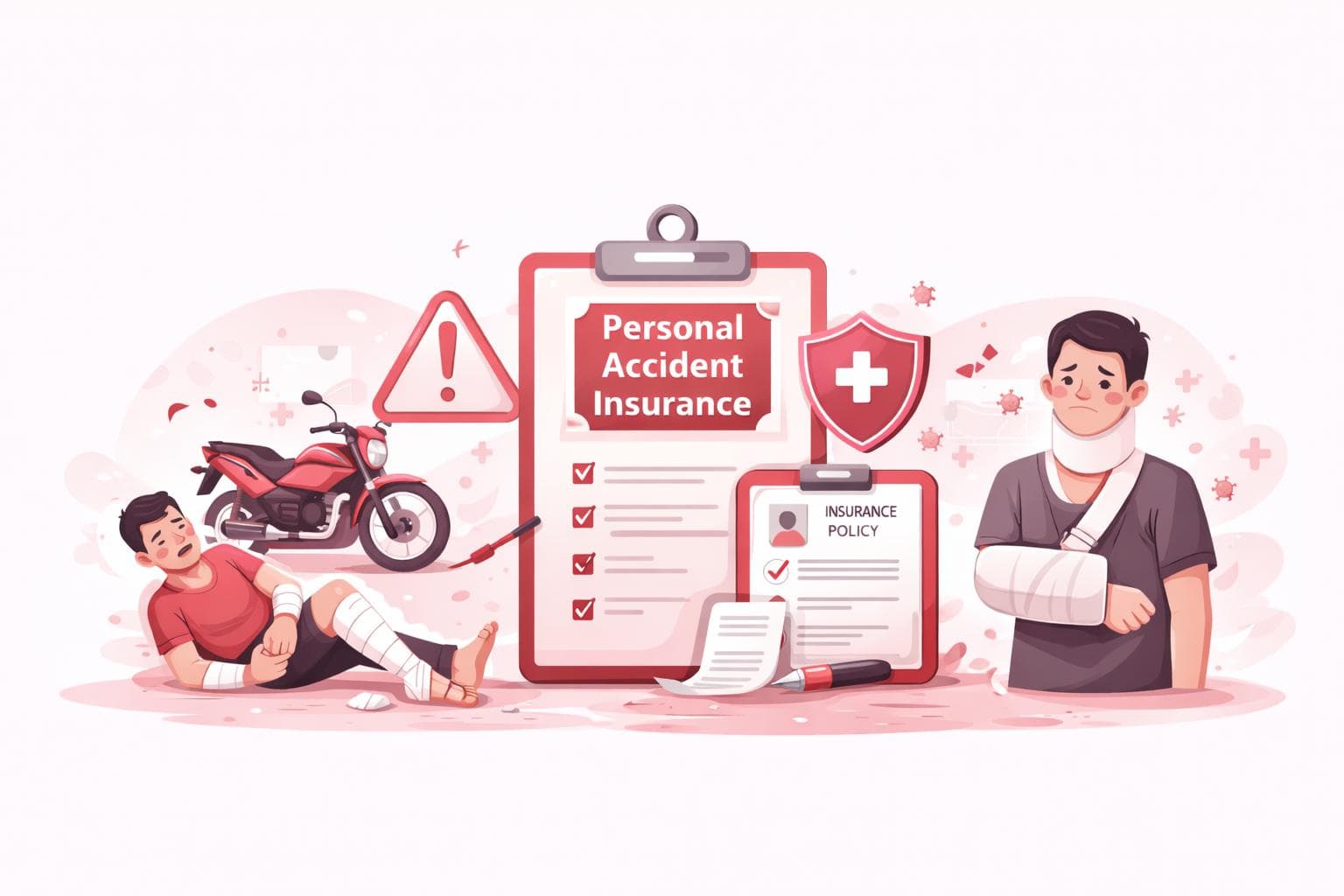
Accidents can happen unexpectedly, whether you are travelling to work, riding a motorcycle, working at an office or spending time with your family. While most people think about health insurance and life insurance, another important form of financial protection is often overlooked: personal accident insurance.
Personal accident insurance in India is designed to provide financial benefits when an insured person suffers specified injuries, disability or death due to an accident covered by the policy.
But what exactly does this insurance cover? Does it pay for hospital bills? What happens if an accident causes permanent disability? And how can a family make a claim?
In this guide, we explain how personal accident insurance works in India, its benefits, limitations, exclusions and important things to check before purchasing a policy.
What Is Personal Accident Insurance?
Personal accident insurance is a type of general insurance that provides financial protection against specified consequences of accidental bodily injuries.
Depending on the policy, benefits may include:
- Accidental death benefit.
- Permanent total disability benefit.
- Permanent partial disability benefit.
- Temporary total disability benefit.
- Accident-related medical expense reimbursement.
- Hospitalisation or other additional benefits, where included.
The exact benefits depend on the policy wording, selected coverage and applicable conditions.
For example, imagine a person has a personal accident policy with an accidental death cover of ₹20 lakh. If that person dies due to an accident covered by the policy, the insurer may pay the eligible benefit to the nominee or legal beneficiary, subject to the policy terms.
Personal accident insurance is different from ordinary health insurance because its main purpose is to cover specified consequences of accidents rather than general medical treatment.
How Does Personal Accident Insurance Work in India?
Personal accident insurance works through a contract between the policyholder and an insurance company.
The policyholder pays a premium for a specified period. In return, the insurer provides the benefits described in the policy if a covered accident occurs.
Here is a simple example:
Suppose Rahul purchases a personal accident policy with the following illustrative benefits:
- Accidental death cover: ₹20 lakh
- Permanent total disability: Up to ₹20 lakh
- Permanent partial disability: According to the policy's benefit schedule
- Additional medical expenses: Only if included in the policy
A few months later, Rahul suffers an accident that results in a covered permanent disability.
The insurer assesses the medical evidence and applies the policy's disability benefit conditions. The payable amount depends on the type and extent of disability and the terms of the contract.
This is why understanding the policy wording is important before purchasing insurance.
What Does Personal Accident Insurance Cover?
Personal accident policies can provide several types of protection.
1. Accidental Death Benefit
This benefit provides financial compensation to the nominee or eligible beneficiary if the insured person dies due to an accident covered by the policy.
The amount payable is generally based on the selected sum insured and policy conditions.
Families may use this financial support to manage household expenses, outstanding obligations and other financial responsibilities.
2. Permanent Total Disability
Permanent total disability refers to a serious accident-related condition that permanently prevents the insured person from performing certain activities or earning a livelihood, as defined by the policy.
Depending on the policy, qualifying conditions may include specified losses of limbs, eyesight or other covered physical functions.
The benefit amount and eligibility criteria must be checked in the policy schedule.
3. Permanent Partial Disability
Sometimes an accident does not result in complete disability but causes permanent loss or impairment of a particular body part or function.
For example, an accident may result in the permanent loss of one finger or partial loss of eyesight.
Some policies pay a percentage of the sum insured based on a disability benefit schedule.
The percentage is not necessarily the same across all insurance policies.
4. Temporary Total Disability
Certain personal accident policies offer temporary total disability benefits.
This benefit may provide a weekly payment if an accident temporarily prevents the insured person from working, subject to medical certification, waiting periods, benefit limits and other conditions.
It can be particularly relevant for people whose income depends on their ability to work.
5. Accident-Related Medical Expenses
Some policies provide reimbursement or defined benefits for eligible medical expenses arising from an insured accident.
However, not every personal accident policy includes this feature.
Before purchasing, check whether the policy includes hospitalisation, ambulance charges, medical expenses or other accident-related treatment benefits.
What Is Not Covered by Personal Accident Insurance?
Personal accident insurance does not cover every medical problem or injury.
Common exclusions or restrictions may include:
- Illnesses and diseases that are not caused by a covered accident.
- Intentional self-inflicted injuries.
- Accidents involving certain illegal activities.
- Injuries associated with alcohol or drug intoxication, where excluded.
- Certain hazardous sports or activities unless specifically covered.
- War-related risks or other specified events.
- Claims that do not satisfy the policy's definition of an accident.
These are examples, not a universal exclusion list. Exclusions differ between insurers and products.
Important: Always read the policy's exclusions, definitions and special conditions. Do not assume that every accident-related event is automatically covered.
Personal Accident Insurance vs Health Insurance vs Term Life Insurance
Many people confuse these three types of insurance because all of them provide financial protection.
However, they serve different purposes.
| Feature | Personal Accident | Health Insurance | Term Life Insurance |
|---|---|---|---|
| Main purpose | Accident-related protection | Medical expenses | Family financial protection after death |
| Illness coverage | Generally no | Yes, subject to terms | Not a medical expense benefit |
| Accidental death | If covered | Generally not its main purpose | Usually covered under the basic death benefit, subject to terms |
| Disability benefits | May be included | Not usually the primary purpose | Usually requires additional coverage |
| Hospital expenses | Only if included | Covered as per policy | Not covered as a medical benefit |
These products are not direct substitutes. A person may need different types of protection depending on their financial responsibilities and circumstances.
How Much Personal Accident Insurance Do You Need?
There is no single coverage amount that is suitable for everyone.
The amount of protection should depend on factors such as:
- Your annual income.
- Number of financial dependants.
- Outstanding loans and liabilities.
- Household expenses.
- Existing insurance coverage.
- Your occupation and accident exposure.
- Whether your employer already provides accident insurance.
For example, a person with substantial family responsibilities may need more financial protection than someone with fewer dependants.
Do not select a policy based only on the advertised sum insured. Check what events trigger payment and how much the policy actually pays for each type of disability.
8 Things to Check Before Buying Personal Accident Insurance
Before purchasing a personal accident policy in India, review these eight important points.
1. Sum Insured
Check the maximum benefit available under the policy and whether different benefits have separate limits.
2. Disability Benefit Schedule
Understand how permanent total and partial disability are defined and how compensation is calculated.
3. Policy Exclusions
Read the exclusions carefully, particularly those relating to hazardous activities, intoxication and specific types of accidents.
4. Medical Expense Coverage
Check whether hospitalisation and accident-related medical expenses are included or require an additional benefit.
5. Temporary Disability Benefits
If you depend on regular income, check whether the policy provides temporary disability payments and understand the eligibility conditions.
6. Occupation Restrictions
Some policies may have different eligibility conditions or exclusions for particular occupations and activities.
Provide accurate occupation and lifestyle information when completing the proposal form.
7. Claim Documentation
Check which documents are required for accidental death, disability and medical expense claims.
8. Premium and Renewal Conditions
Compare the premium with the actual benefits, coverage limits, exclusions and renewal conditions.
A cheaper premium does not automatically mean better protection.
How to File a Personal Accident Insurance Claim in India
If an accident occurs, follow the insurer's claim procedure as soon as reasonably possible.
The general process is:
Step 1: Inform the insurance company
Contact the insurer through its official claims helpline, website or branch and obtain a claim reference number.
Step 2: Seek medical treatment
Get appropriate medical attention and keep all medical reports, prescriptions, bills and discharge summaries.
Step 3: Collect accident-related documents
Depending on the incident, relevant documents may include:
- Completed claim form.
- Copy of the insurance policy.
- Identity and address proof.
- Medical reports and hospital records.
- Accident or police report, where applicable.
- Disability certificate, if relevant.
- Death certificate and post-mortem report, where applicable.
- Nominee or beneficiary documents for death claims.
Step 4: Submit the claim
Provide the required documents through the insurer's official claim submission process.
Step 5: Respond to verification requests
The insurer may request additional information, medical assessments or supporting documents.
Step 6: Receive the claim decision
The insurer assesses the claim against the policy terms and communicates its decision.
The documents and process can vary depending on the nature of the accident and the benefits being claimed.
What Should You Do If an Insurance Claim Is Rejected?
A rejected insurance claim does not mean you have no further options.
First, request the insurer's written explanation and understand the exact reason for rejection.
Check whether the decision is related to:
- A policy exclusion.
- Incomplete documentation.
- A condition not covered by the policy.
- Incorrect or inconsistent information.
- Failure to satisfy a policy condition.
If you disagree with the decision, submit a written complaint to the insurer's Grievance Redressal Officer.
If the issue remains unresolved, you can approach IRDAI through its Bima Bharosa grievance platform.
Official website: https://bimabharosa.irdai.gov.in/ (opens in a new tab)
You can also explore the Insurance Ombudsman mechanism where applicable.
Is Personal Accident Insurance Worth Considering?
Personal accident insurance may be worth considering for people who want additional financial protection against the consequences of accidental injuries, disability or death.
It can be particularly relevant for:
- Salaried employees.
- Self-employed individuals.
- Business owners.
- People who travel regularly.
- Individuals with dependants.
- Workers whose income depends on their physical ability.
However, the suitability of a policy depends on its actual coverage, exclusions, price and your existing protection.
Also check whether your employer, bank or another existing insurance policy already provides accident benefits. Avoid assuming that two policies offer identical benefits.
Frequently Asked Questions (FAQs)
1. What is personal accident insurance in India?
Personal accident insurance provides financial benefits for specified consequences of accidental bodily injuries, including accidental death and disability, depending on the policy.
2. Does personal accident insurance cover hospital bills?
Not automatically. Some policies include accident-related medical expense benefits, while others focus primarily on death and disability benefits. Check the policy wording.
3. Is personal accident insurance different from health insurance?
Yes. Health insurance generally covers eligible medical expenses arising from illness or injury, while personal accident insurance focuses on specified accidental outcomes and related benefits.
4. Does personal accident insurance cover natural death?
Generally, accidental death cover does not apply to death caused by natural illness or disease. Check the exact definitions and benefits in the policy.
5. Can self-employed people buy personal accident insurance?
Many insurers offer personal accident policies to eligible self-employed individuals, subject to age, occupation and underwriting conditions.
6. Can I have more than one personal accident insurance policy?
You may be able to hold multiple policies, but the payment of benefits depends on the type of benefit, policy terms and applicable conditions. Disclose existing coverage accurately when applying.
7. Does personal accident insurance cover road accidents?
Road accidents may be covered when they meet the policy's definition of an insured accident and satisfy its conditions and exclusions.
8. How can I check whether an insurance company is authorised in India?
Check the insurer's current registration and details through the official Insurance Regulatory and Development Authority of India (IRDAI) website: https://irdai.gov.in/ (opens in a new tab)
Final Thoughts
Personal accident insurance is one form of financial protection that people often overlook when planning their insurance coverage.
Understanding accidental death benefits, disability protection, exclusions and claim requirements can help you make more informed decisions.
Before purchasing any policy, compare its actual benefits rather than focusing only on the premium or advertised coverage amount.
Most importantly, read the policy wording and verify the latest information directly with the insurer.
Disclaimer: This article is for general educational and informational purposes only. It does not constitute insurance, financial or legal advice or a recommendation to purchase any particular insurance product. Coverage, exclusions, eligibility and claim conditions vary by insurer and policy. Always read the official policy wording before making a decision.
Official References and Further Reading
- IRDAI – Official website: https://irdai.gov.in/ (opens in a new tab)
- IRDAI – Standard Personal Accident Insurance Product guidelines: https://old.irdai.gov.in/ADMINCMS/cms/frmGuidelines_List.aspx?mid=3.4.3 (opens in a new tab)
- IRDAI – Consumer grievance redressal: https://bimabharosa.irdai.gov.in/ (opens in a new tab)
- Government of India – Insurance Consumer Education Portal: https://www.india.gov.in/ (opens in a new tab)
Reviewed for educational accuracy by: FinanceBlogg Editorial Team.
About the author
FinanceBlogg Editorial Team
Editorial Team
The FinanceBlogg editorial team researches and writes educational explainers on personal finance in India. Articles are based on official sources such as the Reserve Bank of India, SEBI, IRDAI and the Income Tax Department, and are updated when rules change.
View profile and articlesSpotted an error? Read our corrections policy and tell us.
Related articles

Health Insurance Claims in India: 9 Mistakes to Avoid Before You Need Hospital Treatment
Learn how to reduce avoidable health insurance claim problems in India. Understand disclosure, exclusions, waiting periods, documents and claim procedures.
· 7 min read
How to Read an Insurance Policy in India: 10 Things to Check Before Buying
Learn how to read an insurance policy in India. Understand coverage, exclusions, waiting periods, deductibles, claim rules and key terms before buying.
· 9 min read

How Term Life Insurance Works in India
How term life insurance works in India: what it pays, exclusions, sum assured and tenure, medical underwriting, nominees, and how a claim is filed.
· 6 min read