Bank Account Lien vs Freeze vs Debit Freeze in India: Meaning, Reasons and How to Remove Restrictions
By FinanceBlogg Editorial Team
Published 10 min read
Editorially reviewed by FinanceBlogg Editorial Team on . How we review articles
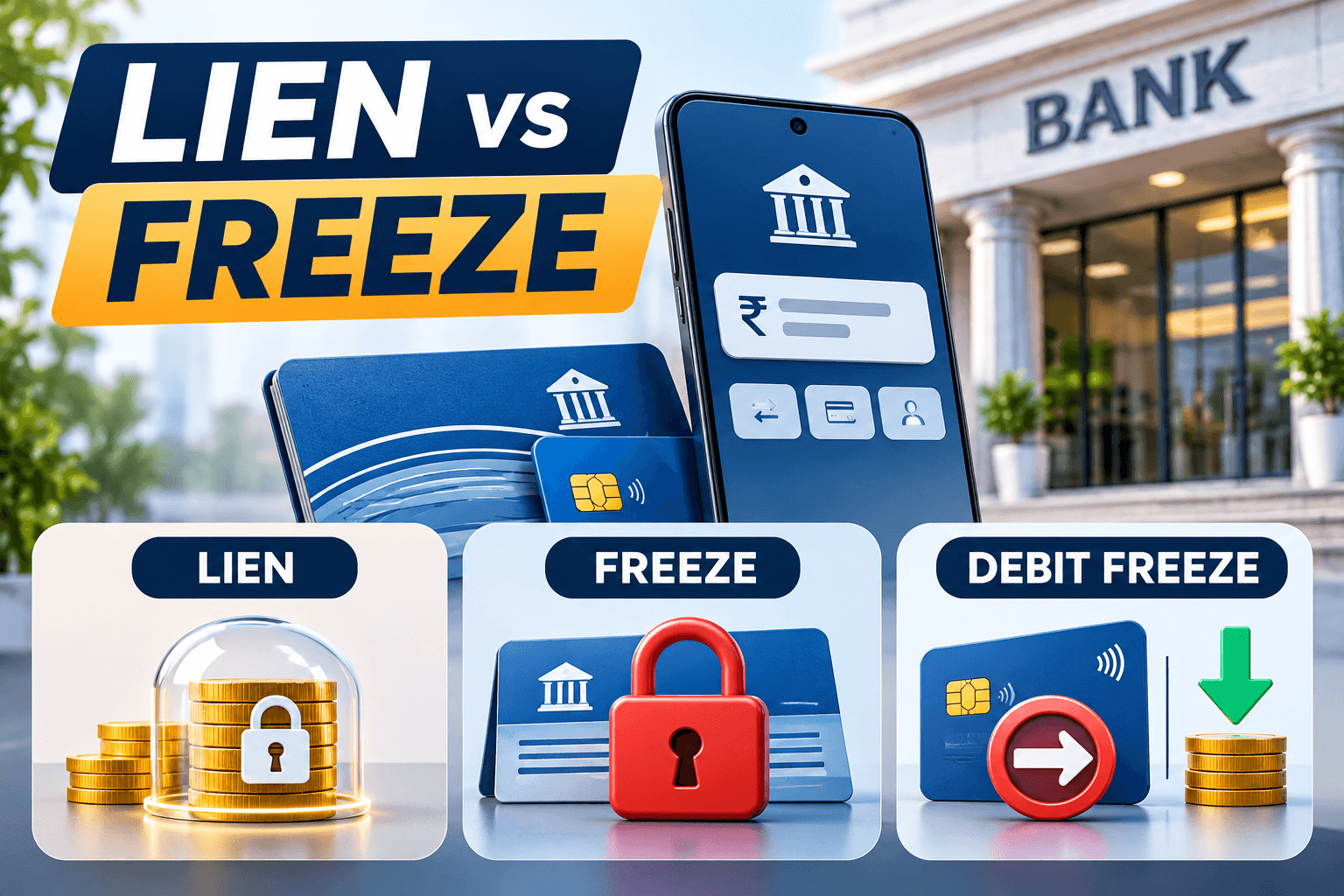
Bank Account Lien vs Freeze vs Debit Freeze in India: Meaning, Reasons and How to Remove Restrictions
Introduction
Imagine opening your banking app and discovering that you cannot withdraw money, transfer funds through UPI or make an online payment. Your account balance is still visible, but some or all of your money appears unavailable.
In India, this situation can happen for several reasons. Your bank account may have a lien, a debit freeze, a complete freeze or another type of restriction.
Although people often use these terms interchangeably, they do not mean the same thing.
Understanding the difference between a bank account lien vs freeze vs debit freeze can help you identify what has happened to your money, ask the bank the right questions and follow the correct resolution process.
In this guide, we explain the common types of bank account restrictions in India, why they happen and what you can do if your account is affected.
1. What Is a Bank Account Lien?
A bank account lien is a restriction placed on a specific amount of money in your account. The bank marks that amount as held or unavailable for withdrawal or use.
The remaining available balance may still be usable, depending on the nature of the lien and any other restrictions.
Example of a Bank Account Lien
Suppose your savings account has ₹50,000.
The bank places a lien of ₹10,000.
| Description | Amount |
|---|---|
| Total account balance | ₹50,000 |
| Amount under lien | ₹10,000 |
| Remaining available balance | ₹40,000 |
In this example, ₹10,000 is blocked, while ₹40,000 may remain available for transactions.
Common Reasons for a Bank Lien
A bank may mark a lien for reasons such as:
- An unpaid loan or credit card obligation, subject to applicable terms and law.
- A fixed deposit used as security for a loan or credit facility.
- A court, tax or other lawful authority's direction.
- A disputed transaction connected to a suspected financial fraud.
- Other contractual or regulatory obligations.
Important: A lien does not automatically mean that your entire bank account is frozen. The actual restriction depends on the bank's instructions and the legal or contractual basis.
2. What Is a Bank Account Freeze?
A bank account freeze is a restriction that can prevent the account holder from carrying out certain or all transactions.
The scope of a freeze depends on the instruction received by the bank or the restriction imposed under applicable rules.
For example, a complete freeze may prevent both incoming and outgoing transactions.
Common Reasons for a Bank Account Freeze
1. Suspicious transactions
Banks may review transactions that appear unusual, inconsistent with the customer's account activity or potentially connected to financial fraud.
2. Cybercrime investigation
If money connected to a reported cyber fraud passes through an account, investigating authorities may request a hold or restriction.
3. KYC issues
Incomplete or outdated Know Your Customer information may result in restrictions under applicable RBI requirements.
4. Court or government authority orders
A competent authority may issue a lawful direction affecting the operation of a bank account.
5. Compliance and fraud prevention
Banks may impose restrictions when required under applicable anti-money laundering, fraud-risk management or other regulatory obligations.
A restriction does not, by itself, establish that the account holder has committed fraud.
3. What Is a Debit Freeze?
A debit freeze means that outgoing transactions from a bank account are restricted.
Depending on the restriction, you may not be able to:
- Withdraw cash from an ATM.
- Transfer money through UPI.
- Send money using IMPS, NEFT or RTGS.
- Make debit card payments.
- Transfer funds through internet or mobile banking.
Incoming credits may still be permitted, depending on the bank's instructions.
Example
Suppose your account has ₹30,000.
The bank places a debit freeze.
You may be unable to withdraw or transfer the money, even though the balance is still visible in your banking app.
However, the account may continue receiving salary or other credits if incoming transactions have not been restricted.
Remember: A debit freeze is not necessarily the same as a complete account freeze.
4. Difference Between Lien, Freeze and Debit Freeze
Understanding these three terms is important because each restriction can affect your money differently.
| Feature | Lien | Debit Freeze | Complete Freeze |
|---|---|---|---|
| Money blocked | Usually a specified amount | Outgoing funds restricted | Account operations restricted |
| Withdrawals | Depends on available balance | Usually not allowed | Not allowed |
| Incoming credits | Depends on instructions | May be allowed | May be blocked |
| UPI payments | Depends on restriction | Usually blocked | Blocked |
| Account access | May remain available | May remain available | Depends on bank |
| Removal | Release of lien | Removal of debit restriction | Release of freeze |
The table describes common meanings, not a universal rule. The exact restrictions must be confirmed with your bank.
5. How to Check Why Your Bank Account Is Restricted
If your account suddenly stops working, do not assume that it is a cybercrime freeze or a lien.
First, identify the actual restriction.
Follow these steps:
Step 1: Contact your bank
Use the official customer care number, mobile banking application, internet banking service or home branch.
Step 2: Request the exact restriction details
Ask the bank whether your account has:
- A lien or amount-specific hold.
- A debit freeze.
- A complete debit and credit freeze.
- A KYC-related restriction.
- A restriction requested by an investigating authority.
- Another internal banking restriction.
Step 3: Request written clarification
Ask for the restriction date, reference number, applicable reason and the department or authority responsible, to the extent the bank is permitted to disclose them.
Step 4: Check your transaction history
Identify any unusual credits or debits, particularly transactions you do not recognise.
Step 5: Keep supporting documents
Save bank messages, statements, complaint acknowledgements, UTR numbers and relevant transaction records.
These documents may be important when requesting removal of a restriction.
6. How to Remove a Lien or Unfreeze a Bank Account in India
The removal process depends on the reason for the restriction. There is no single application that automatically removes every bank account freeze.
Situation 1: Lien Due to a Bank Loan or Credit Facility
If the lien relates to an unpaid obligation or a security arrangement:
- Contact the bank's loan or recovery department.
- Ask for the outstanding amount and the basis for the lien.
- Check your loan agreement and relevant bank documents.
- Resolve the outstanding obligation, if applicable.
- Request written confirmation of lien release.
Situation 2: Restriction Due to KYC Issues
If the restriction relates to incomplete KYC:
- Contact your bank.
- Ask which KYC documents or verification steps are pending.
- Submit the required documents through an official channel.
- Complete any additional verification requested.
- Request confirmation that the restriction has been removed.
Never share your OTP, PIN or internet banking password with anyone claiming to help with KYC.
Situation 3: Account Restricted Due to Cybercrime Investigation
This situation requires additional care.
If the bank informs you that a restriction is connected to a cybercrime complaint:
- Request the available complaint or reference number.
- Ask which investigating agency or police unit issued the instruction.
- Obtain the disputed transaction details, including UTR and amount, where available.
- Contact the relevant investigating officer through verified official channels.
- Submit genuine transaction records, invoices, payment details and other evidence explaining the source of funds.
- Ask the investigating authority to review the restriction and communicate any release instruction to the bank, if appropriate.
- Follow up with the bank using your complaint reference.
You may also seek advice from a qualified lawyer if the restriction continues or affects your business or personal finances significantly.
Do not pay an unknown person who promises guaranteed account unfreezing.
Situation 4: Restriction Due to a Court or Government Order
If the restriction was imposed under a court or other competent authority's direction, the bank may not be able to remove it independently.
Ask for the available order or reference details and consult a qualified legal professional about the appropriate procedure.
7. What If the Bank Does Not Resolve Your Complaint?
If you believe your bank has not properly addressed your service complaint, use its official grievance redressal process.
A practical escalation route is:
Level 1: Bank Customer Support
Register a formal complaint and retain the acknowledgement number.
Level 2: Bank Grievance Redressal Officer
If the first response is unsatisfactory, escalate the complaint to the bank's designated grievance redressal authority.
Level 3: RBI Integrated Ombudsman
For eligible complaints involving deficiency in service by covered regulated entities, you can approach the RBI's grievance redressal mechanism after first approaching the bank and meeting the scheme's maintainability conditions.
The Reserve Bank - Integrated Ombudsman Scheme, 2026 came into effect on 1 July 2026.
You can visit the official RBI Complaint Management System:
https://cms.rbi.org.in/ (opens in a new tab)
The RBI Contact Centre can also provide guidance on the complaint process at 14448.
Important: The RBI Ombudsman is not a substitute for a police investigation or a court proceeding. A complaint about bank service and a request to cancel a lawful investigative restriction are different matters.
8. How to Avoid Bank Account Restrictions
You cannot prevent every lawful bank restriction, but good banking practices can reduce avoidable problems.
- Keep your KYC details updated.
- Use your own bank account for legitimate transactions.
- Avoid receiving money from unknown people.
- Do not allow others to use your bank account for transfers.
- Keep invoices and payment records for business transactions.
- Avoid unexplained third-party transactions.
- Check your account statement regularly.
- Respond promptly to genuine bank verification requests.
- Never share your banking OTP, PIN or password.
If you operate a business, maintain proper records of customer payments, refunds, supplier payments and other transactions.
These records can help explain the source and purpose of funds if a transaction is questioned.
9. Frequently Asked Questions
1. Can I withdraw money if my bank account has a lien?
It depends on the lien amount and other restrictions. If only a specified amount is under lien, the remaining available balance may be usable.
2. Can I receive money in a debit-freeze account?
Incoming credits may be allowed under a debit freeze. However, the exact restriction depends on the bank's instructions.
3. Does a bank freeze mean that my money is lost?
No. A restriction does not automatically mean that the money has been forfeited. The funds may remain in the account but may not be available for transactions.
4. Can a bank freeze an account because of a suspicious UPI transaction?
A suspicious transaction may lead to a review or restriction, including action connected to a cybercrime investigation. The bank should be asked to explain the nature and basis of the restriction to the extent permitted.
5. How long does it take to remove a bank account freeze?
There is no universal timeline for every type of restriction. The time depends on the reason, required verification, and whether a bank, investigating agency or court must issue a release instruction.
6. Can I open another bank account if one account is frozen?
Opening another account does not automatically remove an existing restriction or resolve an investigation. Any new account must be operated lawfully and with accurate information.
7. Can I complain to RBI if my bank does not remove a lien?
You can raise an eligible complaint about deficiency in the bank's service through the RBI grievance mechanism. However, RBI Ombudsman proceedings do not automatically cancel a valid lien or override a lawful order from an investigating authority or court.
Conclusion
A bank account lien, a debit freeze and a complete account freeze are different types of restrictions.
A lien generally affects a specified amount, a debit freeze restricts outgoing transactions, and a complete freeze may restrict both incoming and outgoing transactions.
If your bank account becomes restricted, first identify the exact reason. Request written clarification, preserve transaction records and follow the appropriate bank or investigating authority process.
Understanding these differences can help you protect your money, avoid unnecessary confusion and take the correct next step.
FinanceBlogg Editorial Note: This article is intended for general financial education in India. Banking restrictions depend on the applicable bank terms, regulatory requirements and legal directions. Always verify your specific situation with the concerned bank or a qualified professional.
Official and Reference Sources
- Reserve Bank of India – Integrated Ombudsman Scheme, 2026: https://www.rbi.org.in/ (opens in a new tab)
- RBI Complaint Management System: https://cms.rbi.org.in/ (opens in a new tab)
- National Cyber Crime Reporting Portal: https://cybercrime.gov.in/ (opens in a new tab)
- Ministry of Home Affairs: https://www.mha.gov.in/ (opens in a new tab)
Last reviewed: November 2026
About the author
FinanceBlogg Editorial Team
Editorial Team
The FinanceBlogg editorial team researches and writes educational explainers on personal finance in India. Articles are based on official sources such as the Reserve Bank of India, SEBI, IRDAI and the Income Tax Department, and are updated when rules change.
View profile and articlesSpotted an error? Read our corrections policy and tell us.
Related articles

Inoperative Bank Account in India: Rules & Reactivation Guide
Learn why bank accounts become inoperative in India, RBI rules, how to reactivate a dormant account, KYC requirements and what happens to your money.
· 7 min read
UPI Payment Failed but Money Debited? Here's What to Do in India
UPI payment failed but money was debited?Learn how to check transaction status,raise a complaint, request a refund and escalate unresolved UPI disputes in India
· 7 min read

What Deposit Insurance Covers in India
How DICGC deposit insurance works in India: the ₹5 lakh limit, what is covered, what is not, and how accounts are counted across branches.
· 5 min read