Tax Year vs Assessment Year in India: What's Changed from 1 April 2026?
By FinanceBlogg Editorial Team
Published 12 min read
Editorially reviewed by FinanceBlogg Editorial Team on . How we review articles
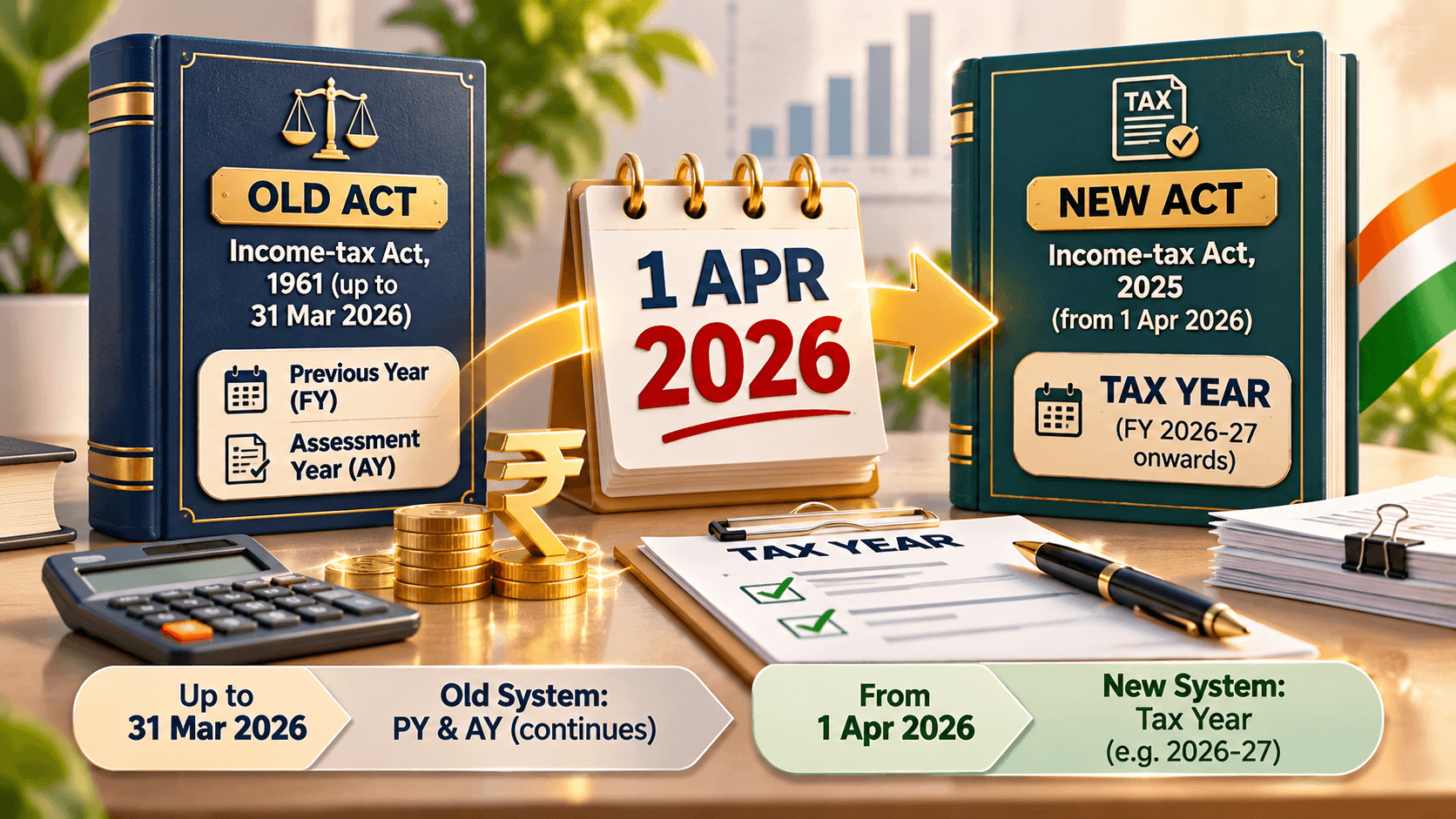
Tax Year vs Assessment Year in India: What's Changed from 1 April 2026?
If you have filed an income tax return in India before, you may be familiar with terms such as Financial Year (FY), Previous Year (PY) and Assessment Year (AY).
For many years, taxpayers used two different year references while dealing with income tax. The Financial Year represented the period in which income was earned, while the Assessment Year represented the following year in which that income was assessed.
However, India's income tax terminology changed from 1 April 2026.
The Income-tax Act, 2025 replaced the Income-tax Act, 1961 and introduced a simplified concept called Tax Year. Under the new system, the terms Previous Year and Assessment Year have been discontinued for tax years governed by the new Act.
This change is intended to make it easier for individuals, salaried employees, freelancers and businesses to understand which year's income is being reported.
But there is an important detail: income earned before 1 April 2026 continues to be governed by the relevant provisions of the old Act under the transition rules.
In this guide, we explain the difference between Financial Year, Previous Year, Assessment Year and Tax Year, with examples for 2026 and 2027.
1. What Is a Tax Year in India?
A Tax Year is a period of twelve months within a financial year, generally beginning on 1 April and ending on 31 March.
The concept was introduced under the Income-tax Act, 2025 and applies from 1 April 2026.
For example:
- Tax Year 2026-27: 1 April 2026 to 31 March 2027.
- Tax Year 2027-28: 1 April 2027 to 31 March 2028.
Under the new system, taxpayers generally use the same year reference for the period in which they earn income and the applicable tax year.
This replaces the earlier terminology of Previous Year and Assessment Year for periods governed by the new Act.
Official reference: Income Tax Department – FAQs on the Income-tax Act, 2025.
2. What Was the Difference Between Financial Year, Previous Year and Assessment Year?
Before 1 April 2026, the Income-tax Act, 1961 used three important terms.
Understanding them is necessary because the old terminology still matters for earlier tax periods.
Financial Year (FY)
A Financial Year is the twelve-month accounting period starting on 1 April and ending on 31 March.
For example, FY 2025-26 means:
1 April 2025 to 31 March 2026.
This is the period during which an individual earns salary, business income, rental income, interest and other taxable income.
Previous Year (PY)
Under the old Income-tax Act, the Previous Year referred to the financial year in which income was earned.
For example:
- Previous Year: 2025-26.
- Income earned: 1 April 2025 to 31 March 2026.
Assessment Year (AY)
The Assessment Year referred to the year immediately following the Previous Year.
It was the year in which the income earned during the Previous Year was assessed and the income tax return was generally filed.
For example:
- Previous Year: 2025-26.
- Assessment Year: 2026-27.
This difference between two year references often confused taxpayers.
3. What Changed Under the Income-tax Act, 2025?
The Income-tax Act, 2025 introduced a simpler year reference.
Instead of referring to the Previous Year and Assessment Year separately, the new Act uses one term: Tax Year.
Here is the main difference:
| Old Income-tax Act, 1961 | New Income-tax Act, 2025 |
|---|---|
| Previous Year (PY) | Tax Year |
| Assessment Year (AY) | Discontinued for new tax years |
| Income period | Financial Year |
| Reference year | Two different year labels |
| Applicable law | Earlier periods |
The new Act aims to simplify the structure and language of tax legislation and make it easier for taxpayers to identify the relevant income period.
The Income Tax Department confirms that the new Act was brought into force on 1 April 2026.
4. FY 2025-26 vs AY 2026-27 vs Tax Year 2026-27
This is one of the most important distinctions taxpayers should understand.
Many people assume that AY 2026-27 and Tax Year 2026-27 refer to the same income period. They do not.
Consider the following table:
| Income earned during | Old terminology | New terminology | Applicable law |
|---|---|---|---|
| 1 Apr 2025 – 31 Mar 2026 | PY 2025-26 / AY 2026-27 | Not applicable as a new tax year | Income-tax Act, 1961 |
| 1 Apr 2026 – 31 Mar 2027 | Not applicable as a new PY/AY period | Tax Year 2026-27 | Income-tax Act, 2025 |
| 1 Apr 2027 – 31 Mar 2028 | Not applicable as a new PY/AY period | Tax Year 2027-28 | Income-tax Act, 2025 |
Important: AY 2026-27 relates to income earned in FY 2025-26. Tax Year 2026-27 relates to income earned in FY 2026-27.
They have the same year numbers but refer to different periods.
5. Practical Example: How the New Tax Year System Works
Let's understand the change with two examples.
Example 1: Income Earned During FY 2025-26
Suppose Rahul works as a salaried employee and earns income between April 2025 and March 2026.
His income period is:
- Financial Year: 2025-26.
- Previous Year: 2025-26.
- Assessment Year: 2026-27.
Even though the new Income-tax Act came into force on 1 April 2026, Rahul's income for FY 2025-26 continues to be governed by the old Income-tax Act, 1961.
The Income Tax Department confirms that returns for AY 2026-27 relating to this earlier period use forms prescribed under the old Act.
Example 2: Income Earned During FY 2026-27
Now suppose Priya earns salary from April 2026 to March 2027.
Her income period is:
- Financial Year: 2026-27.
- Tax Year: 2026-27.
- Applicable law: Income-tax Act, 2025.
After the tax year ends, the applicable income tax return process will follow the new Act and the rules and forms relevant to that period.
There is no separate Assessment Year 2027-28 terminology for this income under the new Act.
These examples show why checking the income period is more important than simply looking at the year number.
6. Why Did the Government Introduce the Tax Year Concept?
One of the objectives of the new Income-tax Act is to simplify India's direct tax legislation.
Previously, taxpayers had to remember two different year references.
For example:
- Income earned in FY 2024-25.
- Tax return generally filed in AY 2025-26.
The new Tax Year terminology brings the income period and its tax-law reference closer together.
According to the Income Tax Department, the new legislation also aims to:
- Simplify statutory language.
- Consolidate scattered provisions.
- Reduce unnecessary cross-references.
- Improve readability.
- Make tax compliance easier to understand.
The new Act contains 536 sections and 16 schedules, compared with 819 sections and 14 schedules in the earlier Act, according to the department's published FAQ.
The change is primarily a restructuring and simplification of the law, not the introduction of a new tax merely because the terminology has changed.
7. Does the Assessment Year Still Exist in India?
Yes, the term Assessment Year still matters when dealing with income earned during periods governed by the Income-tax Act, 1961.
The new Act discontinued the Assessment Year concept for its new Tax Year system.
However, the repeal of the 1961 Act does not invalidate earlier assessments, notices, rights or proceedings.
For example:
- AY 2023-24 continues to relate to income earned in FY 2022-23.
- AY 2026-27 continues to relate to income earned in FY 2025-26.
- Tax Year 2026-27 relates to income earned in FY 2026-27.
The transition provisions under Section 536 of the Income-tax Act, 2025 preserve the treatment of relevant earlier periods and proceedings.
This is why taxpayers may continue to see Assessment Year references on older tax documents, notices and return records.
8. Does the Tax Year Change the Financial Year for Businesses?
No. Businesses and other taxpayers do not need to change their accounting year simply because the Tax Year concept has been introduced.
The normal financial year continues to run from:
1 April to 31 March.
For example, a business with an accounting year from 1 April 2026 to 31 March 2027 will generally use Tax Year 2026-27 under the new Income-tax Act.
There is one special situation.
If a new business or a new source of income starts during a financial year, its Tax Year may be shorter than twelve months.
For example:
A business starts on 1 December 2026.
Its first Tax Year will run from:
1 December 2026 to 31 March 2027.
This treatment is explained in Section 3 of the Income-tax Act, 2025.
9. Does the New Income-tax Act Change GST Rules?
No. The Tax Year change discussed in this article relates to India's direct income tax legislation.
GST continues to be governed by separate legislation, including:
- Central Goods and Services Tax Act, 2017.
- Integrated Goods and Services Tax Act, 2017.
- Applicable State and Union Territory GST laws.
The introduction of Tax Year under the Income-tax Act does not automatically replace GST registration rules, GST return requirements or the GST filing system.
GST taxpayers should continue checking the official GST portal and applicable CBIC notifications for their compliance requirements.
Official reference:
https://cbic-gst.gov.in/ (opens in a new tab)
10. Important Things Every Taxpayer Should Remember
Before preparing an income tax return or responding to a tax notice, remember these points:
1. Identify the income period first.
Check whether the income relates to a period before or from 1 April 2026.
2. Do not confuse AY 2026-27 with Tax Year 2026-27.
They refer to different income periods.
3. Use the applicable income tax law.
Earlier periods continue under the relevant provisions of the 1961 Act, subject to transitional rules.
4. Check the correct section references.
The new Income-tax Act has reorganised the provisions. Do not automatically use old section numbers when dealing with a new Tax Year.
5. Verify the correct forms and return requirements.
Use the official Income Tax Department website to check the forms and filing procedures relevant to the applicable period.
6. Do not assume that tax rates are unchanged forever.
The applicable tax rates, rebates and other provisions must be checked for the relevant tax year under the applicable Finance Act and tax legislation.
Frequently Asked Questions (FAQs)
1. What is the meaning of Tax Year in India?
Tax Year means the twelve-month period of a financial year beginning on 1 April. It is introduced under the Income-tax Act, 2025 and applies from 1 April 2026.
2. Is Assessment Year abolished in India?
The Assessment Year concept has been discontinued for tax years governed by the Income-tax Act, 2025. However, the term remains relevant to earlier income periods and proceedings governed by the old Act.
3. Is Tax Year 2026-27 the same as AY 2026-27?
No. AY 2026-27 relates to income earned during FY 2025-26, whereas Tax Year 2026-27 relates to income earned between 1 April 2026 and 31 March 2027.
4. Which Income-tax Act applies to FY 2025-26?
Income earned during FY 2025-26 continues to be governed by the Income-tax Act, 1961, including the applicable transitional provisions.
5. Which Income-tax Act applies from 1 April 2026?
The Income-tax Act, 2025 applies to tax years beginning on or after 1 April 2026.
6. Do businesses need to change their financial year?
No. The normal financial year continues from 1 April to 31 March. The introduction of Tax Year does not require businesses to change their accounting period.
7. Will old income tax notices remain valid after 1 April 2026?
The repeal of the Income-tax Act, 1961 does not automatically invalidate earlier notices or proceedings. The relevant transitional and savings provisions preserve the applicable treatment of earlier tax periods.
8. Has the new Income-tax Act introduced a new tax?
The Income Tax Department states that the 2025 Act itself does not impose a new tax. The purpose is to simplify and reorganise the existing tax legislation. Applicable tax rates and provisions must still be checked for each relevant tax year.
9. Does Tax Year apply to GST returns?
No. The Tax Year concept discussed here belongs to the Income-tax Act, 2025. GST continues under its separate GST laws and return framework.
10. Where can I check the new Income-tax Act sections?
You can visit the official Income Tax Department website to read the Income-tax Act, 2025, the Income-tax Rules, 2026 and the provision-mapping utility.
Official website: https://www.incometaxindia.gov.in/ (opens in a new tab)
Conclusion
The introduction of Tax Year under the Income-tax Act, 2025 is an important change in India's income tax terminology.
From 1 April 2026, the new system uses Tax Year instead of the earlier Previous Year and Assessment Year terminology for new tax periods.
However, taxpayers should not assume that all earlier Assessment Year references have disappeared. Income earned before 1 April 2026, including income relating to AY 2026-27, continues to be dealt with under the relevant provisions of the old Act and its transitional arrangements.
The most important thing is to identify the correct income period before filing a return, checking a tax document or responding to a notice.
Understanding this transition can help salaried employees, freelancers and business owners avoid confusion and use the correct tax rules.
Official Sources and Further Reading
-
Income Tax Department – Objective and Scope of the New Act FAQs
https://www.incometax.gov.in/iec/foportal/help/all-topics/e-filing-services/objective-and-scope-new-act-faq (opens in a new tab) -
Income Tax Department – Income-tax Act, 2025
https://www.incometaxindia.gov.in/income-tax-act-20251_old (opens in a new tab) -
Income Tax Department – New Act and Rules
https://www.incometax.gov.in/ (opens in a new tab) -
Press Information Bureau – Income-tax Act, 2025 Comes into Force from 1 April 2026
https://www.pib.gov.in/PressReleasePage.aspx?PRID=2248005 (opens in a new tab) -
CBIC – Official GST Information
https://cbic-gst.gov.in/ (opens in a new tab)
Disclaimer
This article is intended for general educational purposes only. It does not constitute personal tax, financial, legal or accounting advice. Tax laws, rates, rules and filing requirements may change. Always verify the applicable provisions through the official Income Tax Department website and consult a qualified Chartered Accountant or tax professional for individual tax matters.
About the author
FinanceBlogg Editorial Team
Editorial Team
The FinanceBlogg editorial team researches and writes educational explainers on personal finance in India. Articles are based on official sources such as the Reserve Bank of India, SEBI, IRDAI and the Income Tax Department, and are updated when rules change.
View profile and articlesSpotted an error? Read our corrections policy and tell us.
Related articles
GST Input Tax Credit (ITC) in India: How to Check, Claim and Avoid Common Mistakes (2026 Guide)
Learn how GST Input Tax Credit works in India,eligibility rules, GSTR-2B reconciliation,how to claim ITC in GSTR-3B and common mistakes businesses should avoid.
· 8 min read
Income Tax vs GST in India: Rules, Differences, Registration and Filing Guide (2026)
Understand income tax vs GST in India, who must pay or register, tax rules, GST returns, filing basics and common compliance mistakes.
· 11 min read
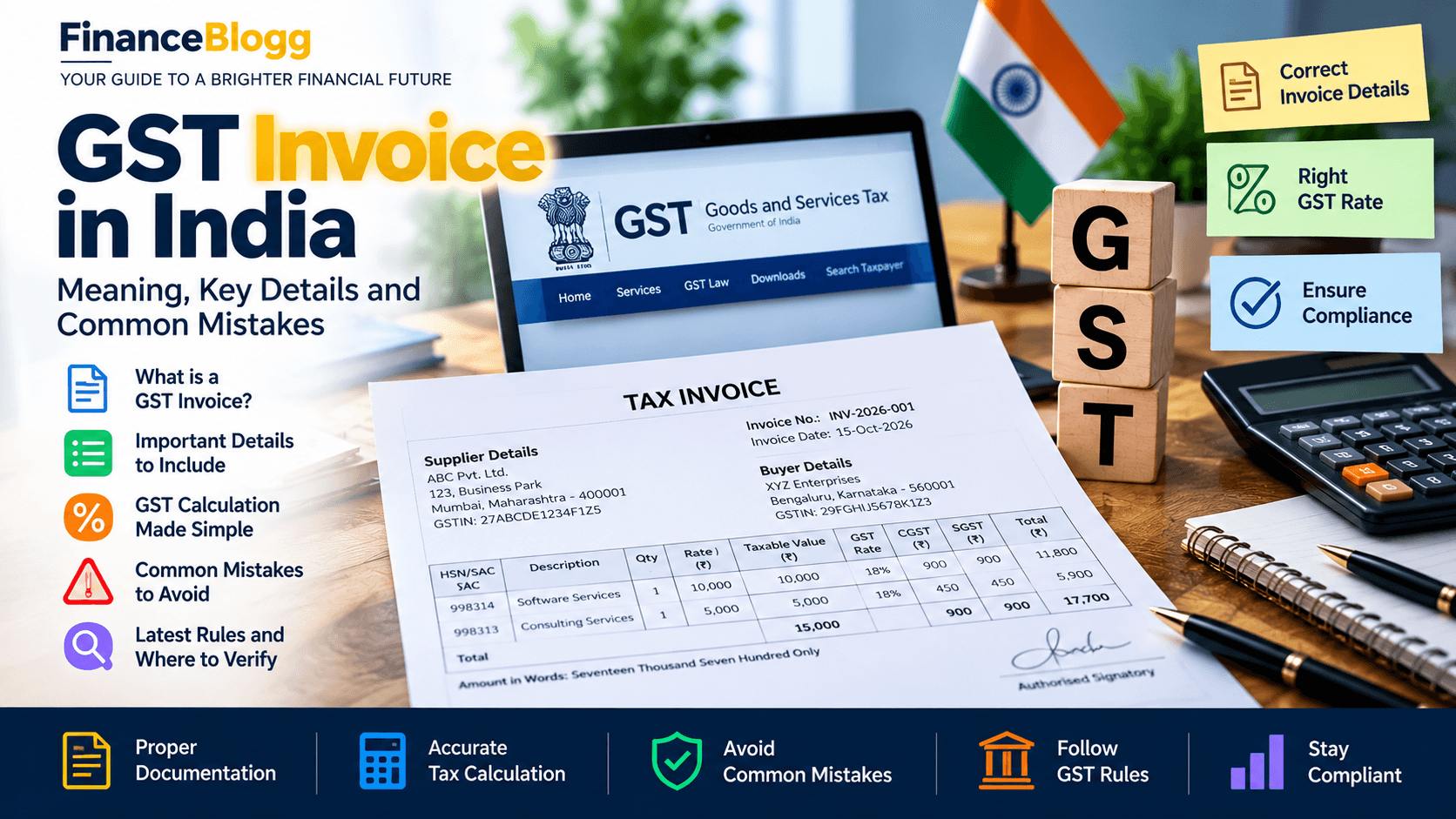
GST Invoice in India: Meaning, Key Details and Common Mistakes
Learn what a GST invoice is in India, the important invoice details, tax calculation basics, common mistakes and where to verify GST compliance.
· 4 min read